
GRASP: planning by gradient descent
INFO
Esta página ainda não foi traduzida. Leia em inglês

GRASP (code) plans with a world model by gradient descent instead of sampling. The latents along the plan become free variables, so each step is predicted on its own instead of through the whole rollout; noise on those latents helps escape local minima, and a periodic sync with a real rollout keeps the plan feasible.
Here a small LeWM learns Two-Rooms from pixels, and GRASP and CEM plan with it toward goals in the other room.
import importlib.util

if importlib.util.find_spec("torch_world") is None:  # on Colab
%pip install -q "torch-world[examples]"import torch
from torch.utils.data import DataLoader
from torch_world import evaluation, plots
from torch_world.datasets import TrajectoryDataset
from torch_world.envs import TwoRooms
from torch_world.models import LeWM
from torch_world.nn import CLSEncoder
from torch_world.planning import CEM, GRASP
from torch_world.utils import fit
torch.manual_seed(0)
device = "cuda" if torch.cuda.is_available() else "cpu"
SKIP = 5 # as in LeWM, the model sees every 5th frame and the 5 actions in betweenData and model
A point wanders through two rooms joined by a door. A small LeWM learns from the pixels with next-embedding prediction and SIGReg.
data = TwoRooms(batch_size=1024, device=device).collect(50, generator=torch.Generator().manual_seed(0))
loader = DataLoader(TrajectoryDataset(data, window=4, frameskip=SKIP), batch_size=256, shuffle=True, drop_last=True)

encoder = CLSEncoder(img_size=64, patch_size=8, depth=6, num_heads=6)
model = LeWM(encoder, action_dim=2 * SKIP, depth=6, num_heads=8, head_dim=32, mlp_dim=768, proj_dim=768, lamb=0.05).to(device)
log = fit(model, loader, epochs=20)
plots.curves(log, smooth=100)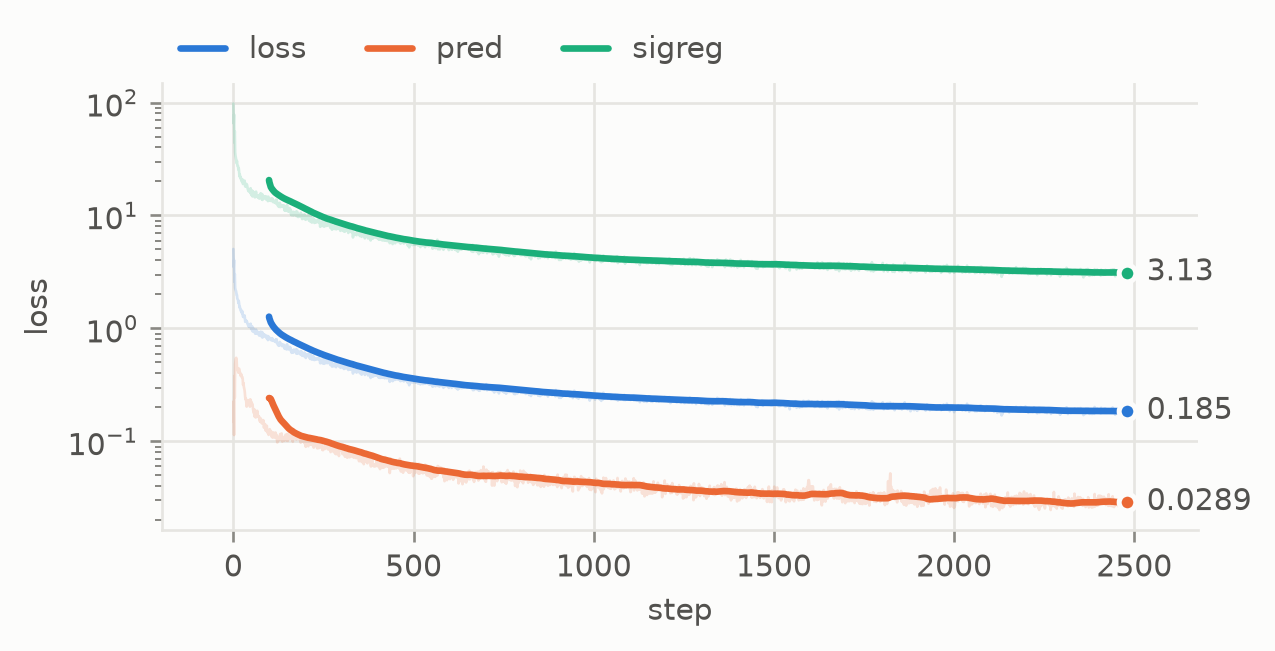
Plan with CEM and GRASP
Both plan 5 chunks of 5 actions on the same model and run the first chunk before planning again. CEM uses LeWM's settings (300 samples, 30 iterations); GRASP those of the authors' LeWM adapter (750 gradient steps, a sync every 50).
env = TwoRooms(batch_size=32, device=device)
start, goal = env.tasks(generator=torch.Generator().manual_seed(1))  # start and goal in opposite rooms
goal_images = env.render(goal)

planners = {
    "CEM": CEM(horizon=5, action_dim=2 * SKIP, num_samples=300, num_elites=30, iterations=30, bounds=(-1, 1)),
    "GRASP": GRASP(horizon=5, action_dim=2 * SKIP, bounds=(-1, 1)),
}
policies = {name: evaluation.goal_policy(model, p, goal_images, action_dim=2, execute=1) for name, p in planners.items()}
policies["random actions"] = evaluation.random_policy(env)
result = evaluation.goal_reaching(env, policies, start, goal, steps=60, success="reached")
result success reached steps final distance progress SPL smoothness ms / step
CEM 62% [45%, 77%] 62% 29.1 0.181 0.558 0.206 0.528 5.88e+03
GRASP 22% [11%, 39%] 22% 12.3 0.574 -0.074 0.0675 0.728 4.13e+03
random actions 3% [1%, 16%] 3% 46 0.545 0.0791 0.00503 1.04 0.0825plots.bars({"Two-Rooms": result.intervals()}, xlabel="success rate", baseline="random actions")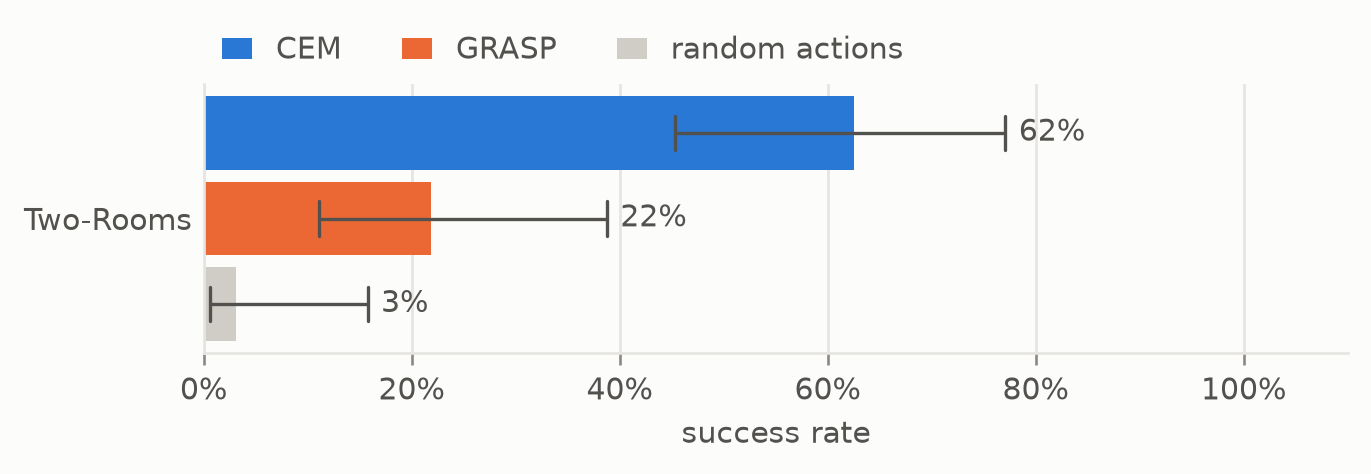
The paths of GRASP; the darker, the later:
plots.trajectories(result.paths["GRASP"][:8], goal[:8], radius=env.radius, background=goal_images[:8], success=result.success["GRASP"][:8])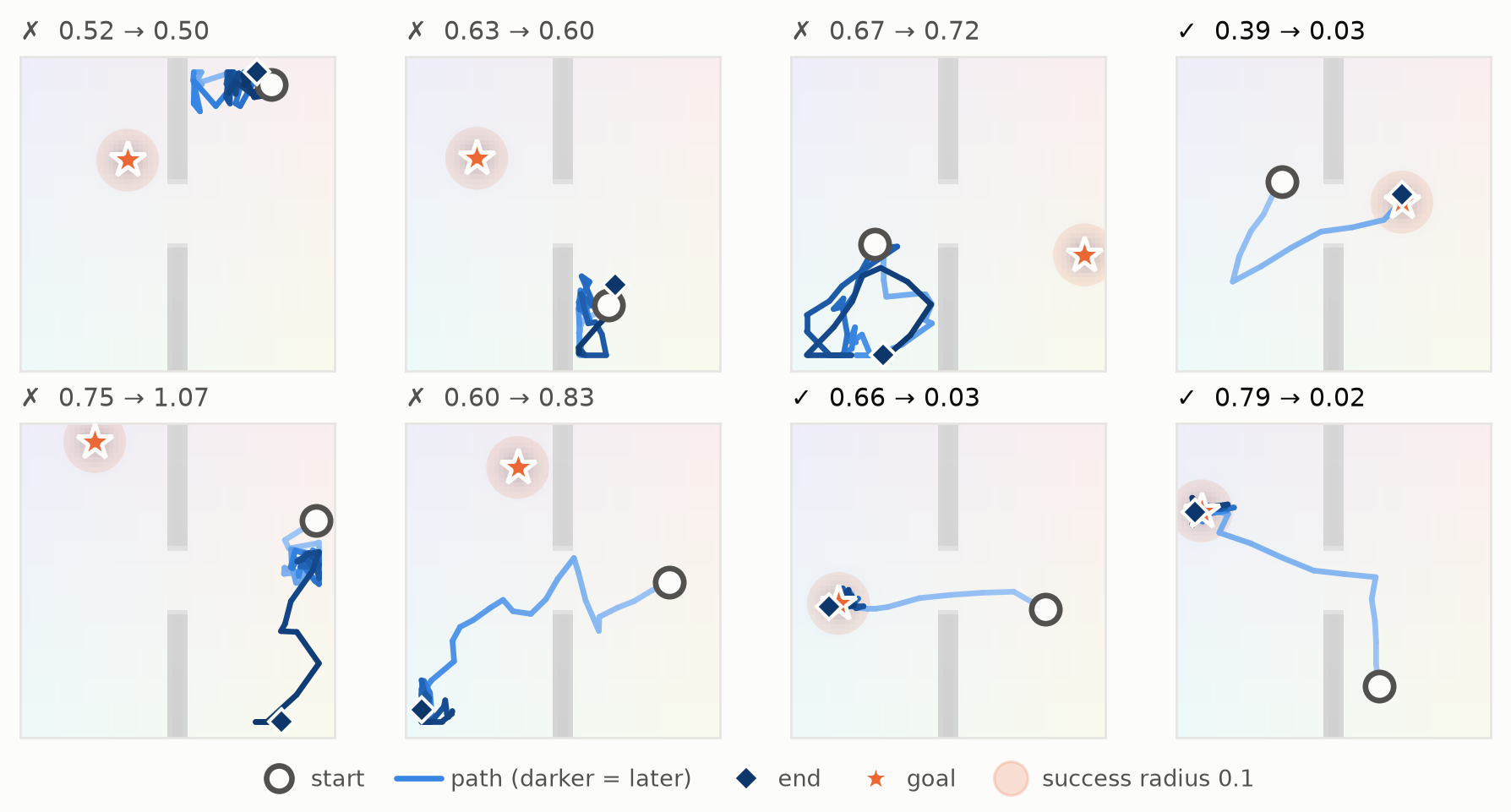
Summary
GRASP is a drop-in alternative to CEM, with the same call planner(model, z, goal) on any differentiable WorldModel. It refines one plan per task by gradient descent where CEM rolls out hundreds of samples per iteration; the ms / step column above compares their cost. Its knobs are iterations, the learning rates of latents and actions, the latent noise, and how often and how hard the plan is synced with a real rollout (sync_every, sync_steps, sync_lr).