
Frozen vs end-to-end encoders
INFO
Esta página ainda não foi traduzida. Leia em inglês

Should a world model reuse a large pre-trained encoder, or learn a small one from its own data? Four encoders, each under an action-conditioned predictor, on PLDM's Two-Rooms:
| encoder | pre-trained on | during world-model training |
|---|---|---|
| DINOv2 ViT-S/14 | web images | frozen (DINO-WM) |
| V-JEPA 2.1 ViT-B | web video | frozen (DINO-WM predictor) |
| LeJEPA ViT | these frames, first | frozen (LeWM predictor) |
| LeWM ViT | nothing | trained end to end |
We compare success, training time and how many parameters each run trains.
import importlib.util

if importlib.util.find_spec("torch_world") is None:  # on Colab
%pip install -q "torch-world[examples]" timm einopsimport time
import torch
from torch import nn
from torch.utils.data import DataLoader
from torch_world import evaluation, plots
from torch_world.datasets import TrajectoryDataset
from torch_world.envs import TwoRooms
from torch_world.models import DINOWM, LeJEPA, LeWM
from torch_world.nn import MLP, CLSEncoder, PatchTokens, VideoTokens
from torch_world.planning import CEM
from torch_world.utils import fit
torch.manual_seed(0)
device = "cuda" if torch.cuda.is_available() else "cpu"Data
A point wanders through two rooms joined by a door, keeping its previous action 80% of the time: 1024 episodes of 65 steps, no rewards, no expert. Every model trains on the same episodes, cut into windows of the length its recipe uses.
data = TwoRooms(batch_size=1024, device=device).collect(65, generator=torch.Generator().manual_seed(0))


def loader(window):
    return DataLoader(TrajectoryDataset(data, window=window), batch_size=128, shuffle=True, drop_last=True)
Pre-train LeJEPA on the frames
LeJEPA learns an encoder from single frames, with no actions: four color-jittered views of a frame should embed alike, and SIGReg keeps the embeddings Gaussian. The jitter changes colors only, so the position stays visible.
def vit():
    return CLSEncoder(img_size=64, patch_size=8, embed_dim=128, depth=4, num_heads=4)


def views(batch):
    frames = batch["pixels"][:, 0]
    return ((frames[:, None] * (0.7 + 0.6 * torch.rand(len(frames), 4, 3, 1, 1, device=device))).clamp(0, 1),)


tic = time.time()
lejepa = LeJEPA(vit(), MLP([128, 512, 128], norm=nn.BatchNorm1d)).to(device)
lejepa_log = fit(lejepa, loader(1), epochs=5, inputs=views)
pretrain_minutes = (time.time() - tic) / 60
plots.curves(lejepa_log, smooth=50)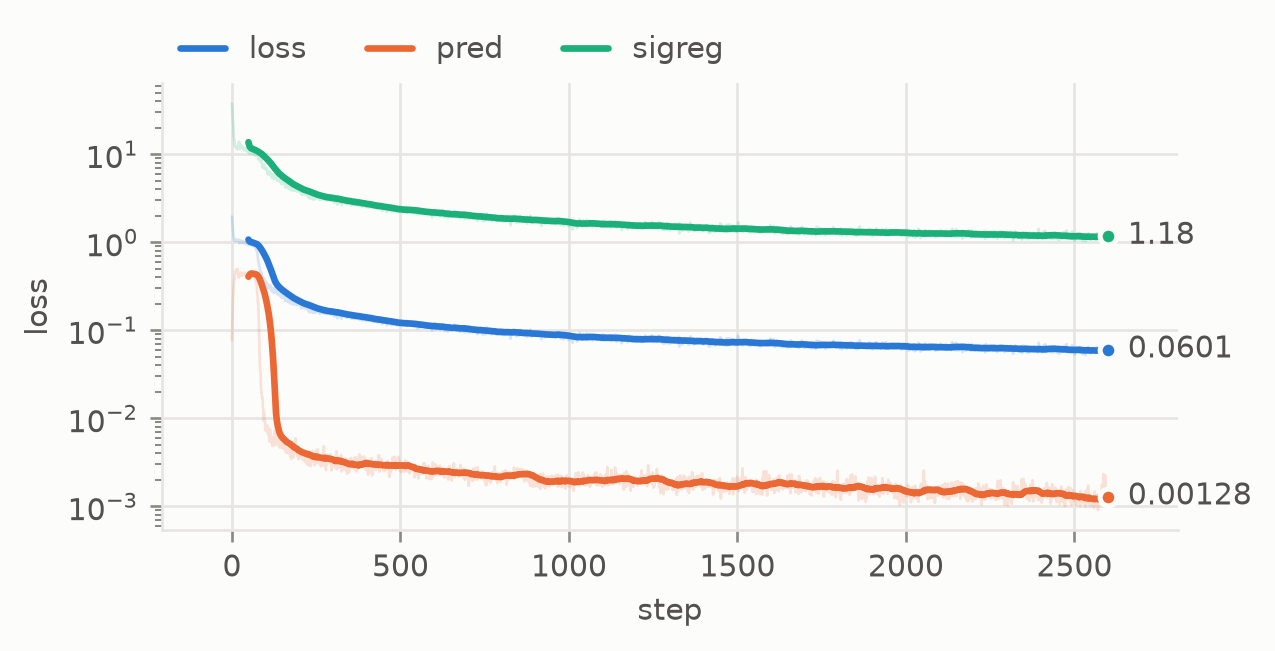
Four world models
The frozen web encoders feed DINO-WM's patch predictor; the frozen LeJEPA encoder and the end-to-end one feed LeWM's.
predictor = dict(depth=4, num_heads=4, head_dim=32, mlp_dim=512)
models = {
    "DINOv2, frozen": DINOWM(PatchTokens.from_hub("dinov2_vits14", size=56), num_patches=16, embed_dim=384, action_dim=2, **predictor),
    "V-JEPA 2.1, frozen": DINOWM(VideoTokens.from_hub("vjepa2_1_vit_base_384", size=64), num_patches=16, embed_dim=768, action_dim=2, **predictor),
    "LeJEPA, frozen": LeWM(lejepa.encoder.requires_grad_(False), action_dim=2, embed_dim=128, proj_dim=512, lamb=0.05, **predictor),
    "LeWM, end to end": LeWM(vit(), action_dim=2, embed_dim=128, proj_dim=512, lamb=0.05, **predictor),
}
logs, cost = {}, {}
for name, model in models.items():
    tic = time.time()
    logs[name] = fit(model.to(device), loader(4), epochs=5)["loss"]
    trained = sum(p.numel() for p in model.parameters() if p.requires_grad) / 1e6
    total = sum(p.numel() for p in model.parameters()) / 1e6
    cost[name] = dict(minutes=(time.time() - tic) / 60, trained=trained, total=total)
    print(f"{name:20s} {cost[name]['minutes']:5.1f} min   {trained:5.2f}M of {total:6.2f}M parameters trained")
print(f"(LeJEPA pre-training: {pretrain_minutes:.1f} min more)")
plots.curves(logs, smooth=50)/clusterhome/kleyton/pytorch-world-roadmap-20261022/pydeps/timm/models/layers/__init__.py:49: FutureWarning: Importing from timm.models.layers is deprecated, please import via timm.layers
warnings.warn(f"Importing from {__name__} is deprecated, please import via timm.layers", FutureWarning)DINOv2, frozen 7.5 min 2.45M of 24.51M parameters trained/clusterhome/kleyton/.local/share/uv/python/cpython-3.12.13-linux-aarch64-gnu/lib/python3.12/contextlib.py:105: FutureWarning: `torch.backends.cuda.sdp_kernel()` is deprecated. In the future, this context manager will be removed. Please see `torch.nn.attention.sdpa_kernel()` for the new context manager, with updated signature.
self.gen = func(*args, **kwds)V-JEPA 2.1, frozen 23.2 min 4.84M of 91.67M parameters trainedLeJEPA, frozen 4.5 min 1.52M of 2.34M parameters trainedLeWM, end to end 6.4 min 2.34M of 2.34M parameters trained
(LeJEPA pre-training: 6.6 min more)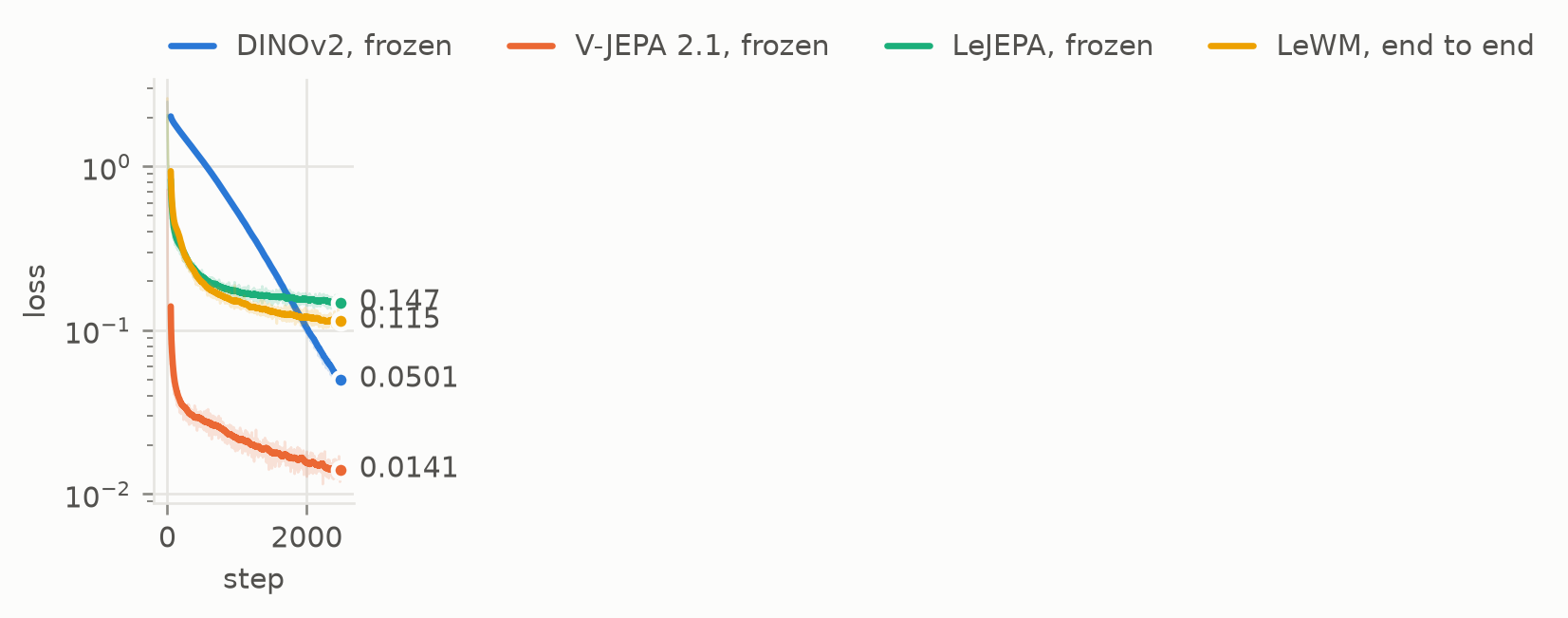
Evaluate
32 tasks with the goal in the same room (short) and 32 with the goal in the other room (long: through the door), 60 steps each. An episode succeeds when it comes within 0.1 of the goal at any step, as in LeWM's and PLDM's protocols; the interval is the 95% Wilson interval.
planner = CEM(horizon=8, action_dim=2, num_samples=128, num_elites=16, iterations=5, bounds=(-1, 1), objective="path")
env = TwoRooms(batch_size=32, device=device)
results = {}
for task, same_room in [("same room", True), ("other room", False)]:
    start, goal = env.tasks(torch.Generator().manual_seed(1), same_room=same_room)
    policies = {name: evaluation.goal_policy(model, planner, env.render(goal)) for name, model in models.items()}
    results[task] = evaluation.goal_reaching(env, policies, start, goal, steps=60, success="reached")
print(f"== {task}\n{results[task]}")/clusterhome/kleyton/.local/share/uv/python/cpython-3.12.13-linux-aarch64-gnu/lib/python3.12/contextlib.py:105: FutureWarning: `torch.backends.cuda.sdp_kernel()` is deprecated. In the future, this context manager will be removed. Please see `torch.nn.attention.sdpa_kernel()` for the new context manager, with updated signature.
self.gen = func(*args, **kwds)== same room
success reached steps final distance progress SPL smoothness ms / step
DINOv2, frozen 91% [76%, 97%] 91% 3.28 0.0368 0.855 0.184 0.433 1.74e+04
V-JEPA 2.1, frozen 91% [76%, 97%] 91% 3.14 0.0316 0.875 0.202 0.528 2.94e+04
LeJEPA, frozen 91% [76%, 97%] 91% 2.52 0.0262 0.883 0.213 0.445 1.23e+03
LeWM, end to end 69% [51%, 82%] 69% 1.95 0.0189 0.876 0.151 0.389 1.23e+03== other room
success reached steps final distance progress SPL smoothness ms / step
DINOv2, frozen 25% [13%, 42%] 25% 4.88 0.595 0.0513 0.0753 0.365 1.73e+04
V-JEPA 2.1, frozen 56% [39%, 72%] 56% 8 0.0731 0.859 0.205 0.618 2.94e+04
LeJEPA, frozen 22% [11%, 39%] 22% 3.86 0.587 0.0356 0.0872 0.438 1.23e+03
LeWM, end to end 38% [23%, 55%] 38% 5.08 0.532 -0.0116 0.139 0.338 1.23e+03plots.bars({task: r.intervals() for task, r in results.items()}, xlabel="success rate")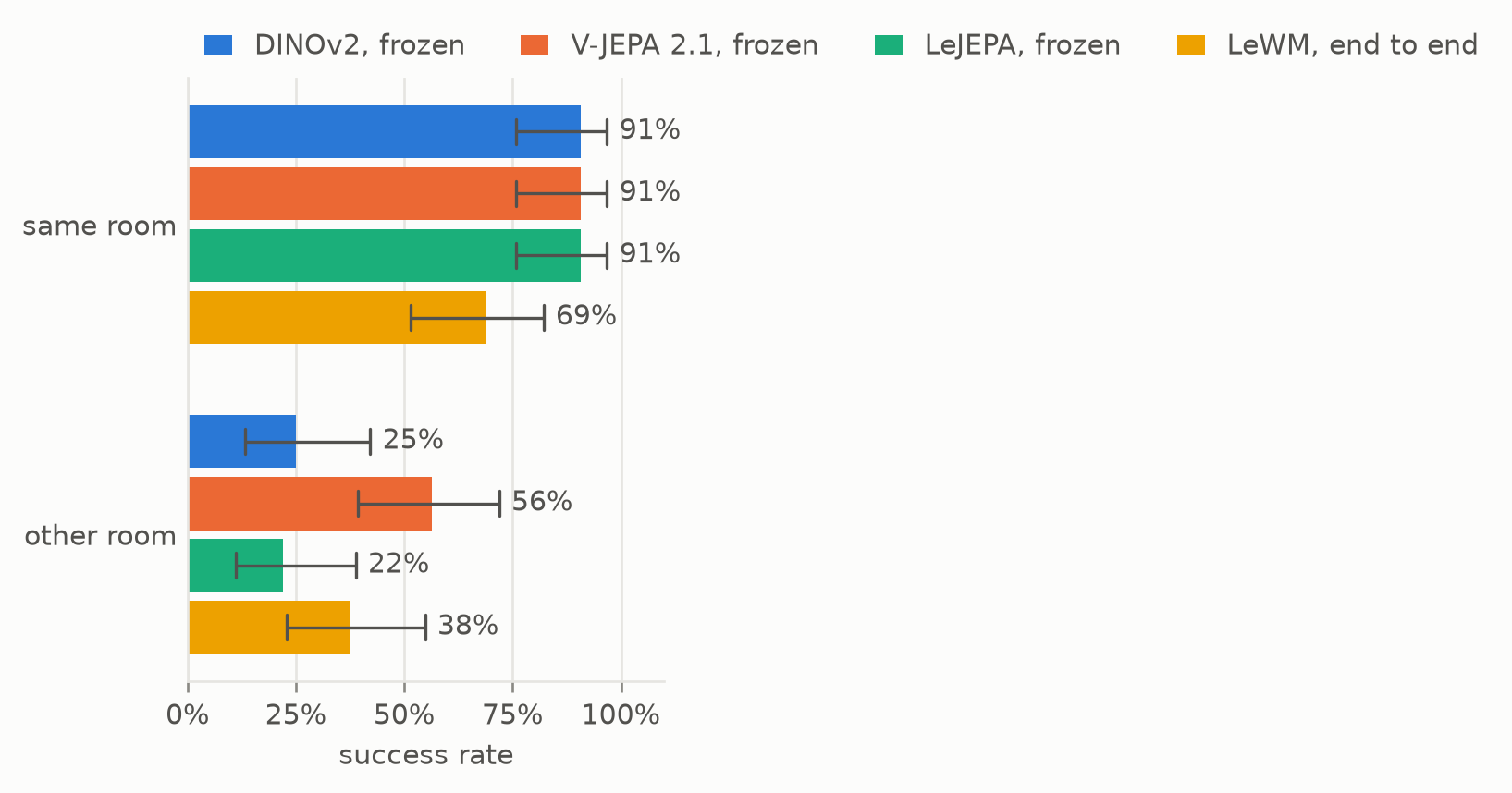
Summary
Web-scale encoders cost nothing to train here but are large to run, and see the scene at their own resolution and statistics; an encoder learned on the task is small and sees exactly what matters. The bars and the table above show which wins on this task, at this scale.