
HWM: hierarchical planning with latent world models
INFO
Esta página ainda não foi traduzida. Leia em inglês

HWM (code) stacks two world models in one latent space. The low level predicts the next latent from an action; the high level predicts the latent a few steps later, a waypoint, from a macro-action that summarizes the actions in between. To plan, the high level finds waypoints to the goal and the low level reaches the first one.
The task is PLDM's Two-Rooms, flown by a macaw: a rock wall splits the sky and the goal is on the other side, so the way there is through the gap.
import importlib.util

if importlib.util.find_spec("torch_world") is None:  # on Colab
%pip install -q "torch-world[examples]"import torch
from torch.utils.data import DataLoader
from torch_world import evaluation, plots
from torch_world.datasets import TrajectoryDataset
from torch_world.envs import Macaw
from torch_world.models import HWM, LeWM
from torch_world.nn import CLSEncoder
from torch_world.planning import CEM, HierarchicalPlanner
from torch_world.utils import fit
torch.manual_seed(0)
device = "cuda" if torch.cuda.is_available() else "cpu"
STRIDE, HISTORY = 4, 3 # one waypoint every 4 steps, 3 waypoints of context
WINDOW = HISTORY * STRIDE + 1Data
The macaw flies at random over the Pantanal, where a rock wall with one gap splits the sky in two, keeping its previous action 80% of the time. No rewards, no expert: just pixels and actions.
data = Macaw(batch_size=1024, rooms=True, device=device).collect(65, generator=torch.Generator().manual_seed(0))
loader = DataLoader(TrajectoryDataset(data, window=WINDOW), batch_size=128, shuffle=True, drop_last=True)
plots.images(data["pixels"][0, :64:8].cpu(), [f"t={t}" for t in range(0, 64, 8)])
Model
The low level is a small LeWM, learned from pixels. The high level is a second predictor over waypoint latents, conditioned on 8-d macro-actions that an MLP encodes from the 4 actions between waypoints.
encoder = CLSEncoder(img_size=64, patch_size=8, embed_dim=128, depth=4, num_heads=4)
low = LeWM(encoder, action_dim=2, embed_dim=128, history=HISTORY, depth=4, num_heads=4, head_dim=32, mlp_dim=512, proj_dim=512, lamb=0.05)
model = HWM(low, action_dim=2, stride=STRIDE, macro_dim=8, embed_dim=128, history=HISTORY, depth=4, num_heads=4, head_dim=32, mlp_dim=512).to(device)
print(f"{sum(p.numel() for p in model.parameters()) / 1e6:.1f}M parameters")3.6M parametersTrain
Both levels train at once with HWM's ℓ1 losses: teacher forcing at both levels and multi-step rollouts at the low level. SIGReg keeps the latents from collapsing; the high level sees them through a stop-gradient, as if the encoder were frozen.
log = fit(model, loader, epochs=6)
plots.curves(log, smooth=50)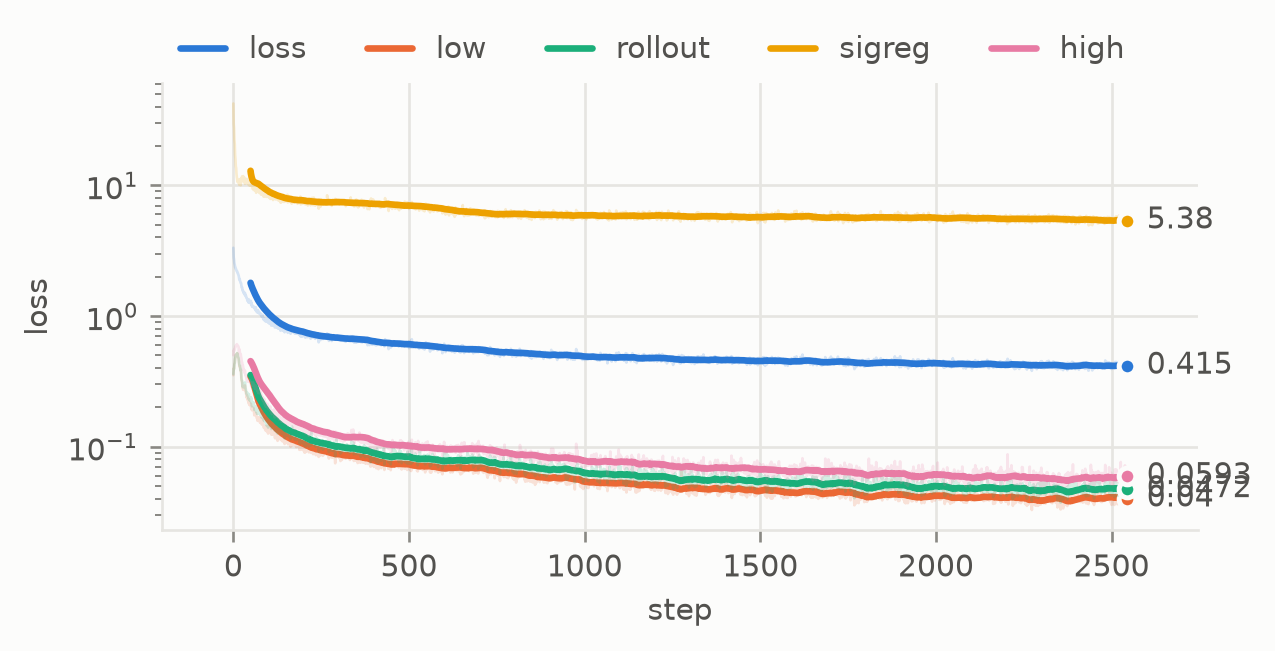
Plan toward goal images across the wall
- hierarchical: CEM over 5 macro-actions (20 steps) toward the goal, then CEM over 4 actions toward the first waypoint;
- flat: CEM over 20 actions on the same model.
Both replan after every step.
env = Macaw(batch_size=32, rooms=True, device=device)
start, goal = env.tasks(generator=torch.Generator().manual_seed(1))  # start and goal on opposite sides of the wall
goal_images = env.render(goal)

hierarchical = HierarchicalPlanner(
    CEM(horizon=5, action_dim=8, num_samples=300, num_elites=30, bounds=(-2, 2)),
    CEM(horizon=STRIDE, action_dim=2, num_samples=256, num_elites=32, iterations=6, bounds=(-1, 1)),
)
flat = CEM(horizon=5 * STRIDE, action_dim=2, num_samples=300, num_elites=30, bounds=(-1, 1))

policies = {
    "hierarchical": evaluation.goal_policy(model, hierarchical, goal_images),
    "flat": evaluation.goal_policy(model, flat, goal_images),
    "random actions": evaluation.random_policy(env),
}
result = evaluation.goal_reaching(env, policies, start, goal, steps=60, success="reached")
result success reached steps final distance progress SPL smoothness ms / step
hierarchical 22% [11%, 39%] 22% 19 0.26 0.471 0.0932 0.419 4.73e+03
flat 72% [55%, 84%] 72% 20.2 0.158 0.675 0.204 0.419 1.51e+04
random actions 16% [7%, 32%] 16% 19.6 0.525 -0.0593 0.0152 1.05 0.0881plots.bars({"other side of the wall": result.intervals()}, xlabel="success rate", baseline="random actions")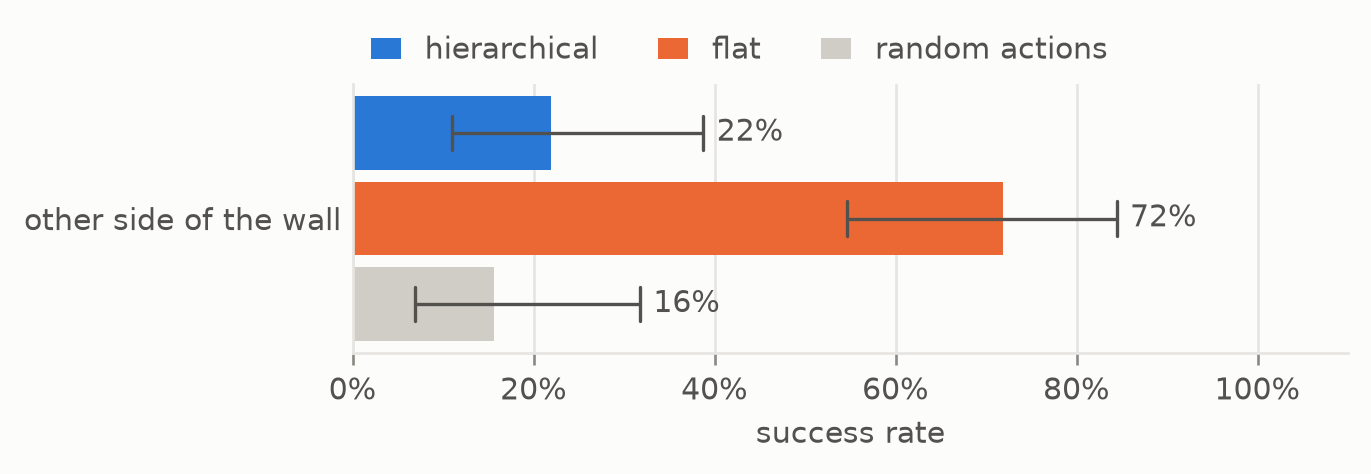
Paths of the hierarchical planner (top row) and the flat one (bottom row); the darker, the later:
paths = torch.cat([result.paths["hierarchical"][:4], result.paths["flat"][:4]])
success = torch.cat([result.success["hierarchical"][:4], result.success["flat"][:4]])
plots.trajectories(paths, goal[:4].repeat(2, 1), radius=env.radius, background=goal_images[:4].repeat(2, 1, 1, 1), success=success)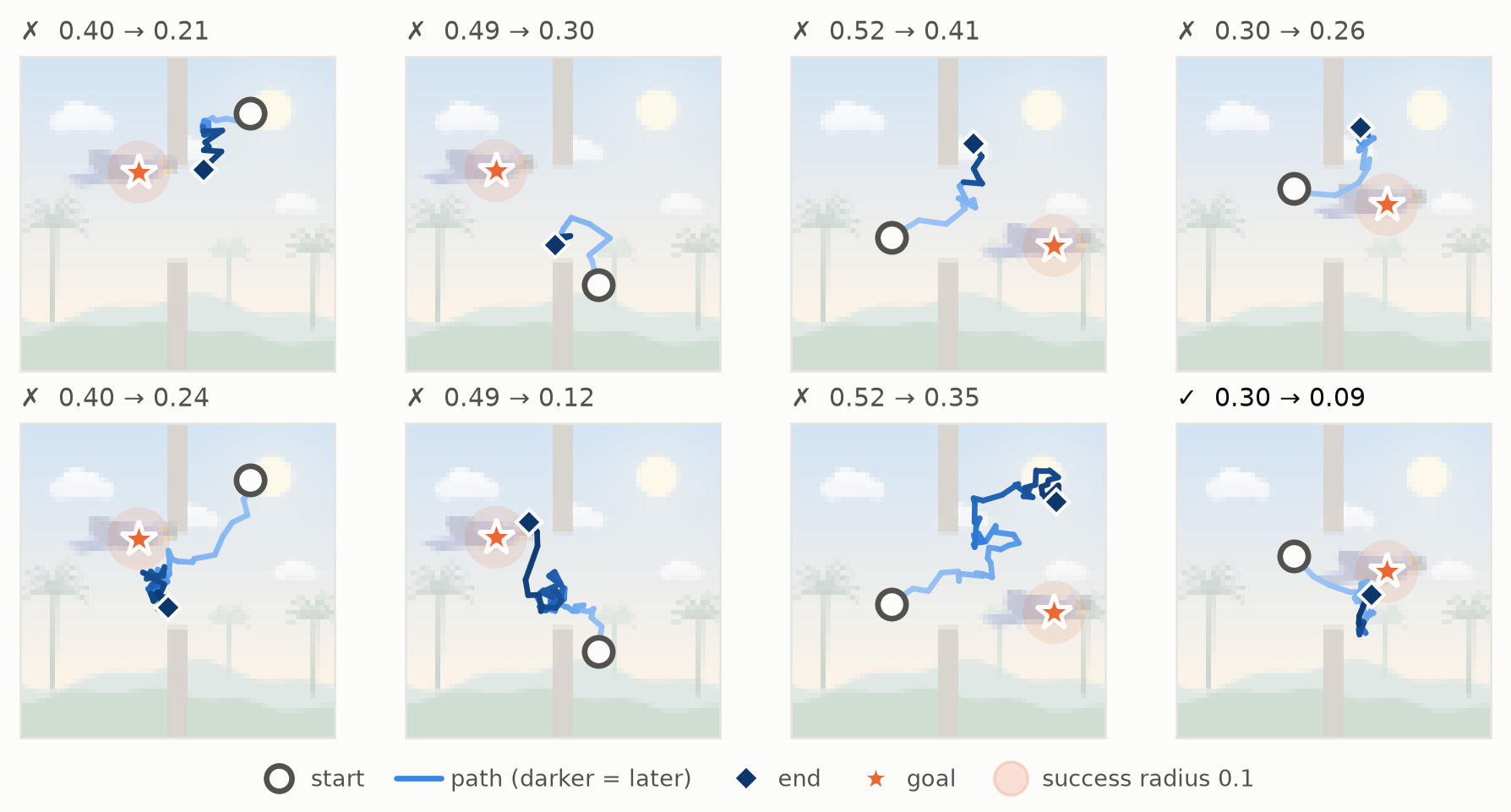
Summary
The high level plans in waypoints four steps apart, so 5 macro-actions span the 20 steps that the flat planner searches action by action. Differences from the paper: the encoder is learned with SIGReg instead of a frozen V-JEPA 2 or DINOv2, waypoints are evenly spaced, the macro-action encoder is an MLP, and both levels plan with CEM.