
Quick start: train a world model and plan with it
INFO
このページはまだ翻訳されていません。 英語版を読む

A world model predicts what comes next. This notebook trains LeWM from pixels, then plans with it: it searches for the actions whose imagined future looks like a goal image. It takes a few minutes on a Colab GPU.
import importlib.util

if importlib.util.find_spec("torch_world") is None:  # on Colab
%pip install -q "torch-world[examples]"import torch
from torch.utils.data import DataLoader
from torch_world import evaluation, plots
from torch_world.datasets import TrajectoryDataset
from torch_world.envs import Macaw
from torch_world.models import LeWM
from torch_world.nn import CLSEncoder
from torch_world.planning import CEM
from torch_world.utils import fit
torch.manual_seed(0)
device = "cuda" if torch.cuda.is_available() else "cpu"1. Collect data
Macaw is a Hyacinth macaw flying over the Pantanal, steered by velocity actions. Its wings beat a quarter cycle per step. Random actions give 2048 flights of 16 frames, seen at 64×64 and cut into windows of 4.
data = Macaw(batch_size=2048, device=device).collect(16)
loader = DataLoader(TrajectoryDataset(data, window=4), batch_size=128, shuffle=True, drop_last=True)
plots.images(data["pixels"][0, :8].cpu(), [f"t={t}" for t in range(8)], size=1.2)
2. Train
A small ViT embeds each frame, and a transformer predicts the next embedding from the past ones and the actions. SIGReg keeps the embeddings from collapsing.
encoder = CLSEncoder(img_size=64, patch_size=8, embed_dim=128, depth=4, num_heads=4)
model = LeWM(encoder, action_dim=2, embed_dim=128, depth=4, num_heads=4, head_dim=32, mlp_dim=512, proj_dim=512, lamb=0.05).to(device)
log = fit(model, loader, epochs=10)
plots.curves(log, smooth=50)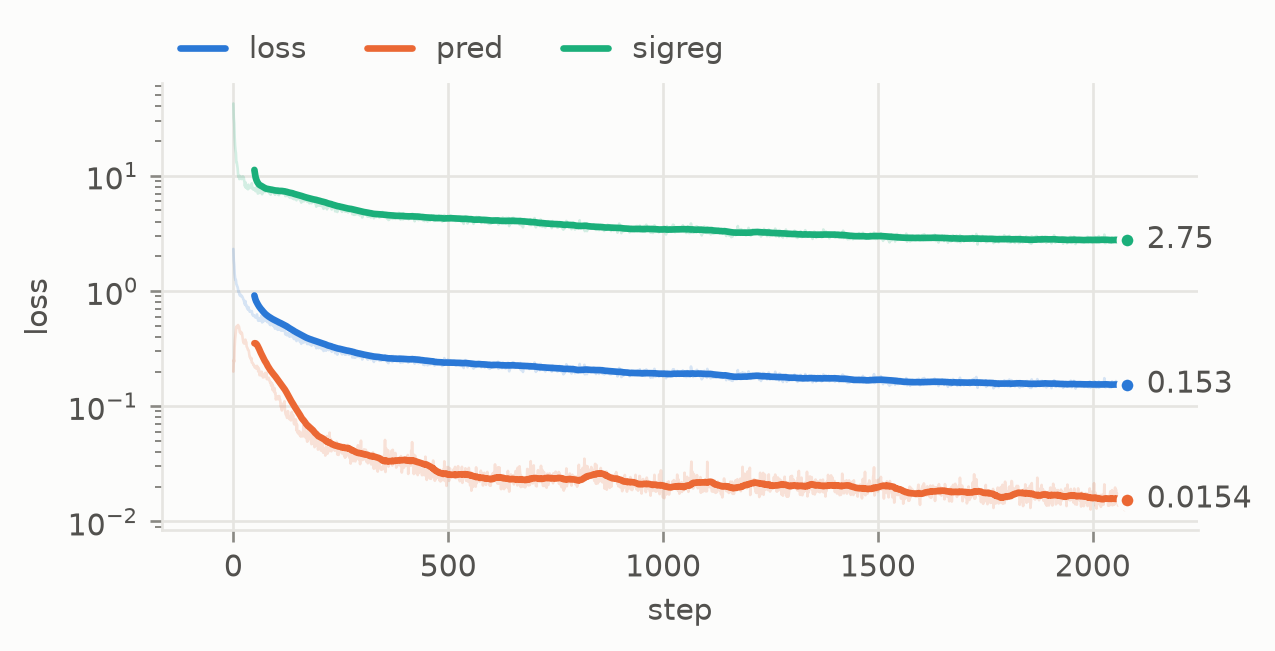
3. Plan toward goal images
Each flight gets the image of the macaw somewhere else. CEM imagines 256 action sequences, keeps those whose imagined embeddings come closest to the goal image's, and refits; the first action runs and it plans again.
env = Macaw(batch_size=32, device=device)
env.reset(generator=torch.Generator().manual_seed(1))
start, goal = env.state.clone(), env.sample_goals((0.2, 0.5), generator=torch.Generator().manual_seed(2))

planner = CEM(horizon=5, action_dim=2, num_samples=256, num_elites=32, bounds=(-1, 1), objective="path")
policies = {
    "LeWM + CEM": evaluation.goal_policy(model, planner, env.render(goal)),
    "random actions": evaluation.random_policy(env),
}
video = Macaw(batch_size=32, size=192, device=device)  # the same states, drawn sharper, with the goal as a ghost
result = evaluation.goal_reaching(env, policies, start, goal, steps=20, success="reached", record=lambda e: video.render(e.state, e.phase, goal=goal))
result success reached steps final distance progress SPL smoothness ms / step
LeWM + CEM 69% [51%, 82%] 69% 2.36 0.0107 0.96 0.467 0.218 2.94e+03
random actions 25% [13%, 42%] 25% 10.2 0.363 -0.0639 0.0483 1.05 0.195plots.bars({"Macaw": result.intervals()}, xlabel="success rate", baseline="random actions")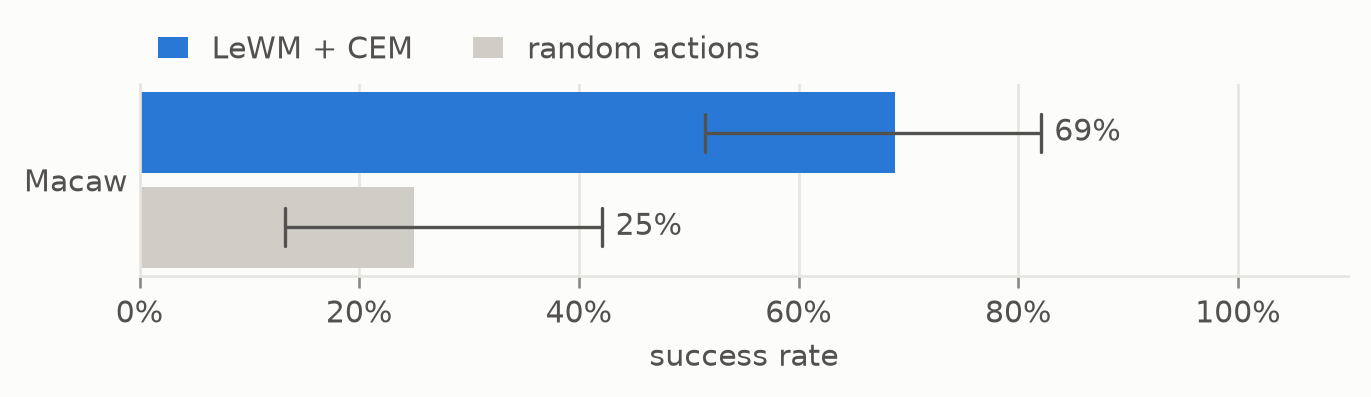
The planner's flights; the translucent macaw marks the goal (in the videos only, the model sees plain frames):
plots.episodes(result.frames["LeWM + CEM"][:8], result.success["LeWM + CEM"][:8])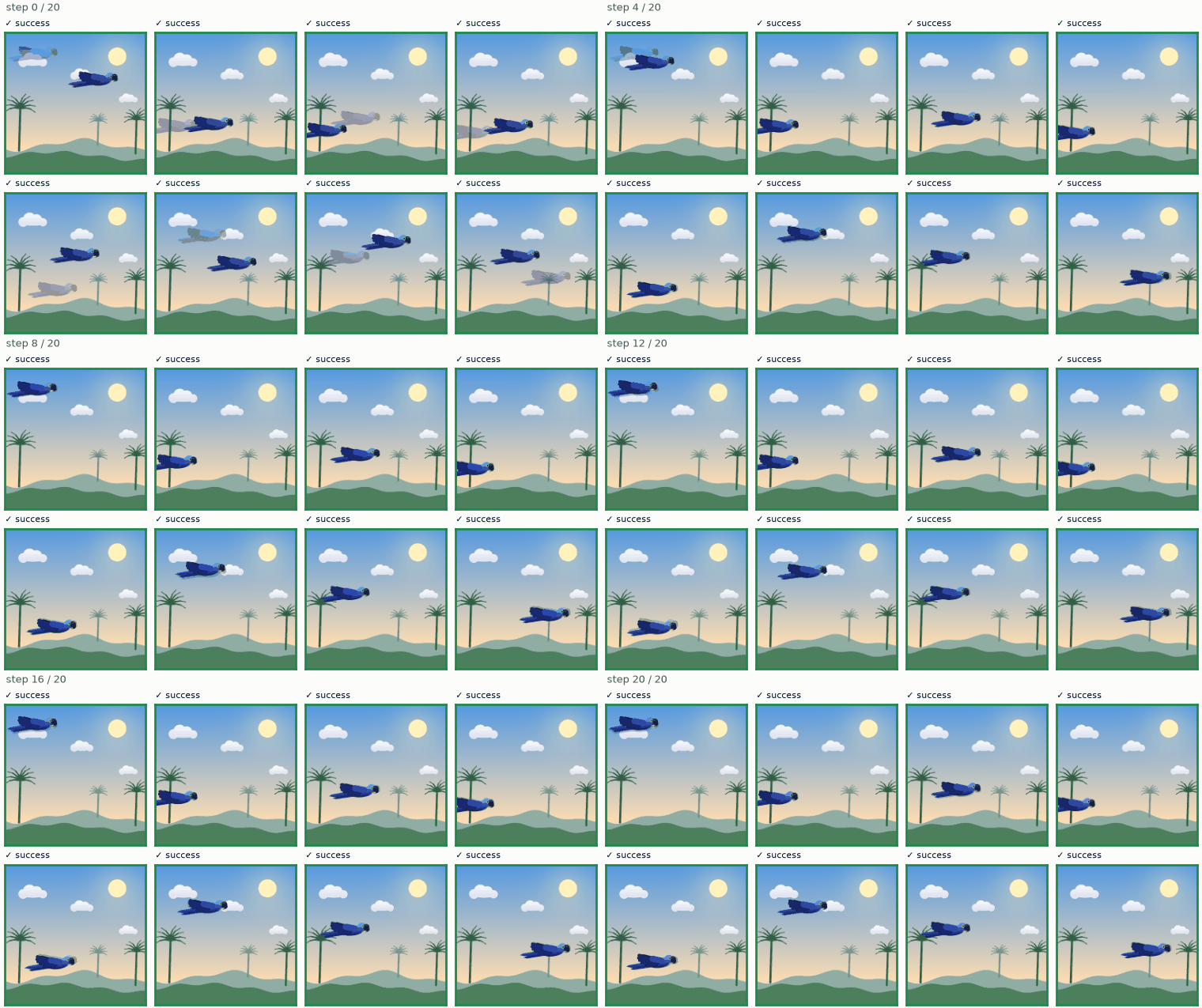
Next
- Models: JEPA world models, DINO-WM, TD-MPC2, PLDM, hierarchical and stochastic models, each with a notebook.
- Comparisons: the same tasks, models and planners side by side.
- Build your own model from the shared parts.