
CF-JEPA: planning past distractors
INFO
このページはまだ翻訳されていません。 英語版を読む

CF-JEPA (code not released) splits a LeWM-style latent into a controllable part and an uncontrollable part. An action-conditioned predictor advances the first, an action-free one the second; an inverse model pulls the action into the controllable part, and an adversary behind a gradient reversal layer pushes it out of the other. The planner compares only the controllable part with the goal, so things that move on their own stop counting as distance.
Here a point crosses two rooms while three colored discs drift through the picture, ignoring the actions. The goal image has the discs somewhere else.
import importlib.util

if importlib.util.find_spec("torch_world") is None:  # on Colab
%pip install -q "torch-world[examples]"import torch
from torch.utils.data import DataLoader
from torch_world import evaluation, plots
from torch_world.datasets import TrajectoryDataset
from torch_world.envs import TwoRooms
from torch_world.models import CFJEPA, LeWM
from torch_world.nn import CLSEncoder
from torch_world.planning import CEM
from torch_world.utils import fit
torch.manual_seed(0)
device = "cuda" if torch.cuda.is_available() else "cpu"Data and model
The point wanders at random, keeping its previous action 80% of the time, while three discs drift on their own: 1024 episodes of 65 steps. Both models get the same small ViT encoder and a predictor of the same depth; CF-JEPA uses 96 of the 128 latent dimensions as its controllable part and gives the other 32 a half-depth, action-free predictor. LeWM is the same model without the split.
data = TwoRooms(batch_size=1024, distractors=3, device=device).collect(65, generator=torch.Generator().manual_seed(0))
loader = DataLoader(TrajectoryDataset(data, window=4), batch_size=128, shuffle=True, drop_last=True)
plots.images(data["pixels"][0, :40:5], titles=[f"t = {t}" for t in range(0, 40, 5)])
def encoder():
    return CLSEncoder(img_size=64, patch_size=8, embed_dim=128, depth=4, num_heads=4)


predictor = dict(depth=4, num_heads=4, head_dim=32, mlp_dim=512, proj_dim=512, lamb=0.09)
models = {
    "CF-JEPA": CFJEPA(encoder(), action_dim=2, embed_dim=128, ctrl_dim=96, alpha=3.0, beta=1.0, **predictor),
    "LeWM": LeWM(encoder(), action_dim=2, embed_dim=128, **predictor),
}
for name, model in models.items():
print(f"{name:8s} {sum(p.numel() for p in model.parameters()) / 1e6:.2f}M parameters")CF-JEPA 2.18M parameters
LeWM 2.34M parametersTrain
Next-embedding MSE and SIGReg for both, plus CF-JEPA's inverse-dynamics loss on the controllable part (
logs = {name: fit(model.to(device), loader, epochs=10, lr=5e-4) for name, model in models.items()}
plots.curves(logs["CF-JEPA"], smooth=100)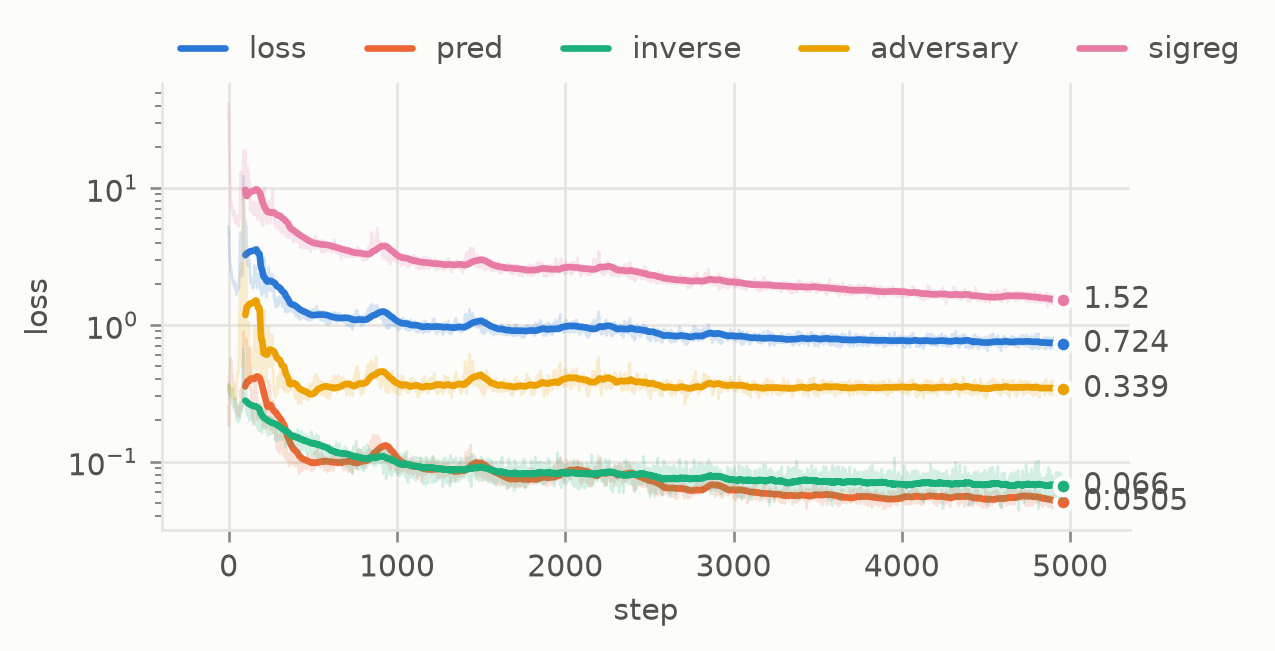
Where the distractors go
Render the same 256 point positions under 8 random placements of the discs and encode them. For each latent (CF-JEPA's two parts, LeWM's whole embedding) the share of its variance that comes from the discs is the variance across placements over the total. A planner that compares latents wants this share near zero.
probe = TwoRooms(batch_size=256, distractors=3)
states = probe.free(256, generator=torch.Generator().manual_seed(2))
gen = torch.Generator().manual_seed(3)
images = []
for _ in range(8):
    probe.reset(states, generator=gen)  # new disc placements, same point positions
    images.append(probe.render(states))
images = torch.stack(images, 1)  # (256, 8, 3, 64, 64)
plots.images(images[0], titles=[f"placement {k}" for k in range(8)])
def distractor_share(z):  # z: (positions, placements, D)
    return (z.var(1).mean() / z.flatten(0, 1).var(0).mean()).item()


with torch.no_grad():
    z_cf = models["CF-JEPA"].encode(images.to(device))
    z_le = models["LeWM"].encode(images.to(device))
zc, zu = models["CF-JEPA"].split(z_cf)
share = {
    "CF-JEPA controllable": distractor_share(zc),
    "CF-JEPA uncontrollable": distractor_share(zu),
    "LeWM": distractor_share(z_le),
}
for name, s in share.items():
print(f"{name:24s} {s:6.1%} of the variance comes from the discs")CF-JEPA controllable 21.4% of the variance comes from the discs
CF-JEPA uncontrollable 82.5% of the variance comes from the discs
LeWM 62.4% of the variance comes from the discsPlan toward goal images
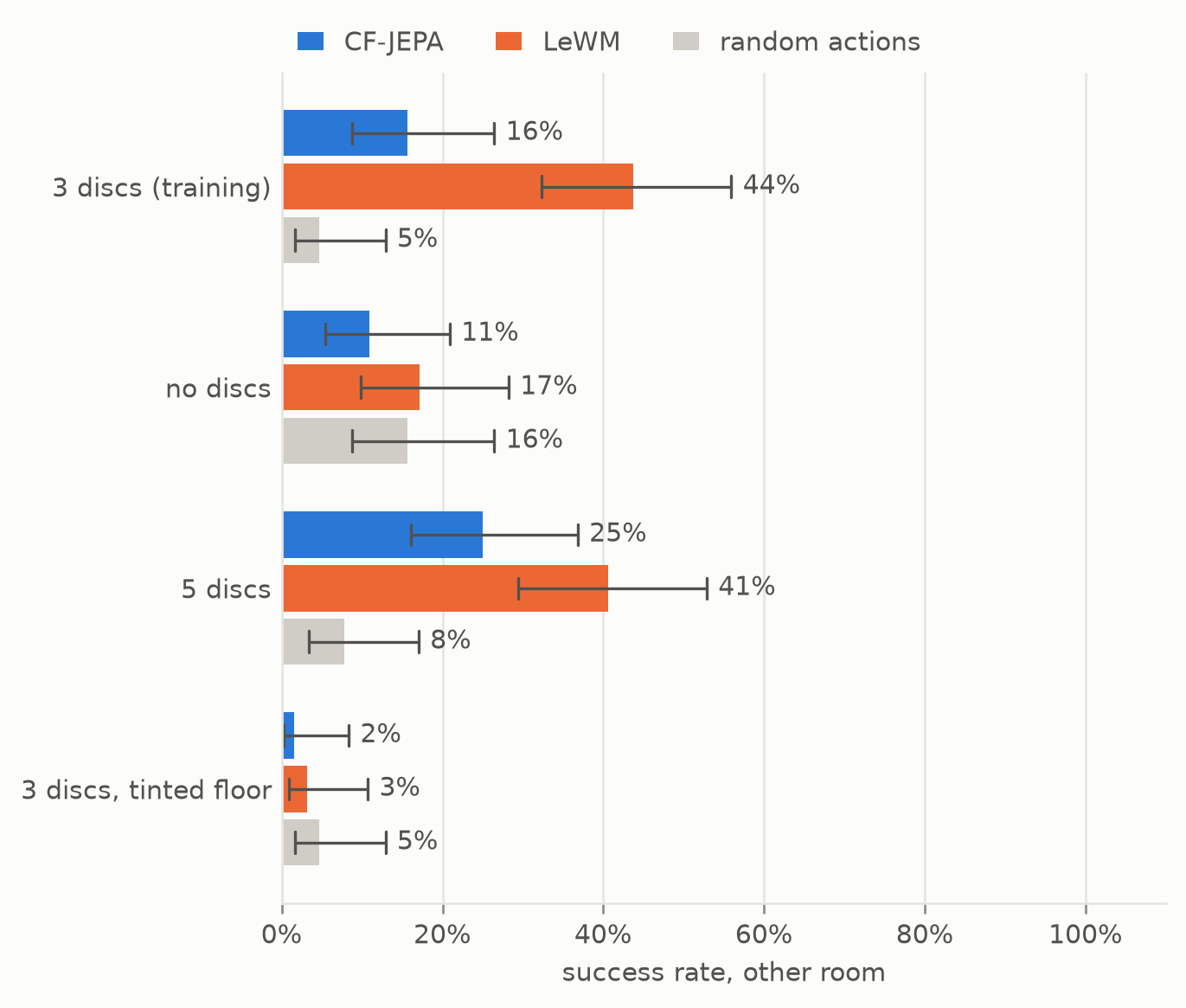
CEM searches 8 actions (128 samples, 16 elites, 5 iterations, averaging the cost along the path) and the policy runs the first one and plans again, for 60 steps; an episode succeeds when the point comes within 0.1 of the goal, as in the main benchmark. Goal images are rendered with the discs elsewhere. Besides the training setting, three shifts the models never saw: no discs, five discs (two in new colors), and three discs on a tinted floor. Each setting has 64 tasks with the goal in the same room and 64 in the other room, through the door.
cem = CEM(horizon=8, action_dim=2, num_samples=128, num_elites=16, iterations=5, bounds=(-1, 1), objective="path")
settings = {
    "3 discs (training)": dict(distractors=3),
    "no discs": dict(distractors=0),
    "5 discs": dict(distractors=5),
    "3 discs, tinted floor": dict(distractors=3, floor=(0.55, 0.75, 0.95)),
}
results, goals = {}, {}
for setting, kwargs in settings.items():
    env = TwoRooms(batch_size=64, device=device, **kwargs)
    for task, same_room in [("same room", True), ("other room", False)]:
        start, goal = env.tasks(torch.Generator().manual_seed(1), same_room=same_room)
        goals[setting, task] = goal
        goal_images = env.render(goal)
        policies = {name: evaluation.goal_policy(model, cem, goal_images) for name, model in models.items()}
        policies["random actions"] = evaluation.random_policy(env)
        results[setting, task] = evaluation.goal_reaching(env, policies, start, goal, steps=60, success="reached")
print(f"== {setting}, {task}\n{results[setting, task]}")== 3 discs (training), same room
success reached steps final distance progress SPL smoothness ms / step
CF-JEPA 84% [74%, 91%] 84% 3.11 0.0368 0.85 0.118 0.554 1.21e+03
LeWM 94% [85%, 98%] 94% 12.2 0.113 0.491 0.13 0.689 1e+03
random actions 47% [35%, 59%] 47% 19.9 0.316 -0.0348 0.027 1.04 0.0136== 3 discs (training), other room
success reached steps final distance progress SPL smoothness ms / step
CF-JEPA 16% [9%, 26%] 16% 10.2 0.65 -0.062 0.0397 0.633 1.21e+03
LeWM 44% [32%, 56%] 44% 27.9 0.384 0.407 0.0886 0.708 1e+03
random actions 5% [2%, 13%] 5% 18 0.609 0.0244 0.00458 1.05 0.0139== no discs, same room
success reached steps final distance progress SPL smoothness ms / step
CF-JEPA 89% [79%, 95%] 89% 2.39 0.0245 0.906 0.178 0.435 1.21e+03
LeWM 91% [81%, 96%] 91% 2.86 0.0397 0.848 0.266 0.419 1e+03
random actions 56% [44%, 68%] 56% 18.6 0.307 0.0212 0.0324 1.05 0.0134== no discs, other room
success reached steps final distance progress SPL smoothness ms / step
CF-JEPA 11% [5%, 21%] 11% 5.14 0.705 -0.12 0.0286 0.536 1.21e+03
LeWM 17% [10%, 28%] 17% 8.45 0.694 0.00408 0.0577 0.557 1e+03
random actions 16% [9%, 26%] 16% 36.8 0.585 -0.00532 0.0219 1.04 0.0134== 5 discs, same room
success reached steps final distance progress SPL smoothness ms / step
CF-JEPA 89% [79%, 95%] 89% 9.68 0.0904 0.617 0.0924 0.727 1.21e+03
LeWM 77% [65%, 85%] 77% 11.6 0.214 0.0498 0.081 0.668 1e+03
random actions 50% [38%, 62%] 50% 15.9 0.324 0.00933 0.0283 1.05 0.0142== 5 discs, other room
success reached steps final distance progress SPL smoothness ms / step
CF-JEPA 25% [16%, 37%] 25% 15.2 0.533 0.0545 0.0483 0.76 1.21e+03
LeWM 41% [29%, 53%] 41% 32.3 0.481 0.275 0.0756 0.659 1e+03
random actions 8% [3%, 17%] 8% 33.2 0.582 0.0269 0.0116 1.04 0.0137== 3 discs, tinted floor, same room
success reached steps final distance progress SPL smoothness ms / step
CF-JEPA 20% [12%, 32%] 25% 1.69 0.529 -0.645 0.0601 0.227 1.21e+03
LeWM 36% [25%, 48%] 42% 10.1 0.564 -0.646 0.0536 0.304 1e+03
random actions 56% [44%, 68%] 56% 19.9 0.306 -0.0532 0.0342 1.04 0.0136== 3 discs, tinted floor, other room
success reached steps final distance progress SPL smoothness ms / step
CF-JEPA 2% [0%, 8%] 2% 6 0.583 -0.11 0.00357 0.239 1.21e+03
LeWM 3% [1%, 11%] 3% 33.5 0.726 -0.145 0.00824 0.303 1e+03
random actions 5% [2%, 13%] 5% 48 0.636 -0.000762 0.00702 1.02 0.0138shifted = {name: TwoRooms(batch_size=4, **kwargs).render(start[:4].cpu()) for name, kwargs in settings.items()}
plots.images(torch.cat(list(shifted.values())), ncols=4, rows=list(shifted))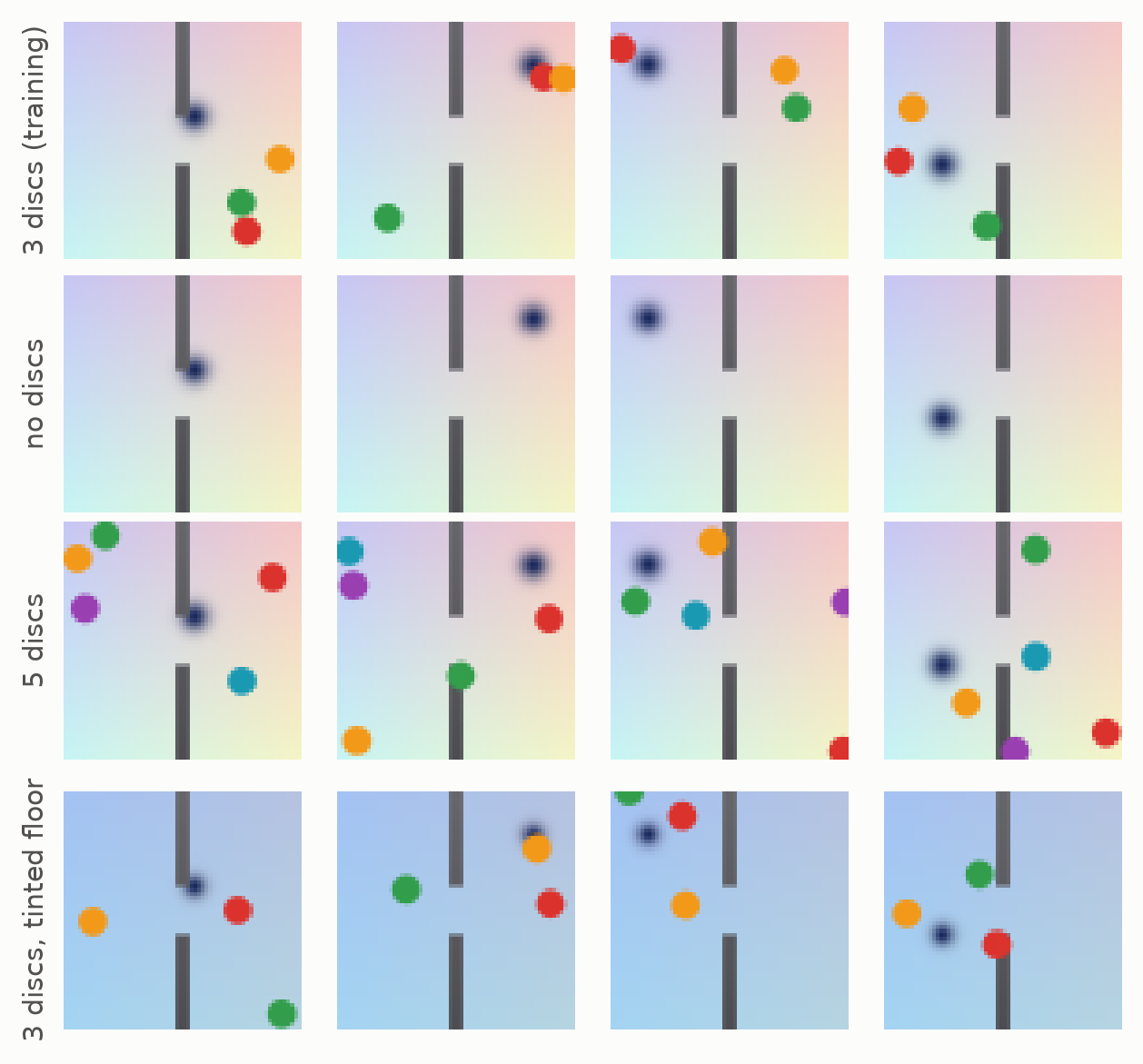
for task in ["same room", "other room"]:
    display(plots.bars({s: results[s, task].intervals() for s in settings}, xlabel=f"success rate, {task}", baseline="random actions"))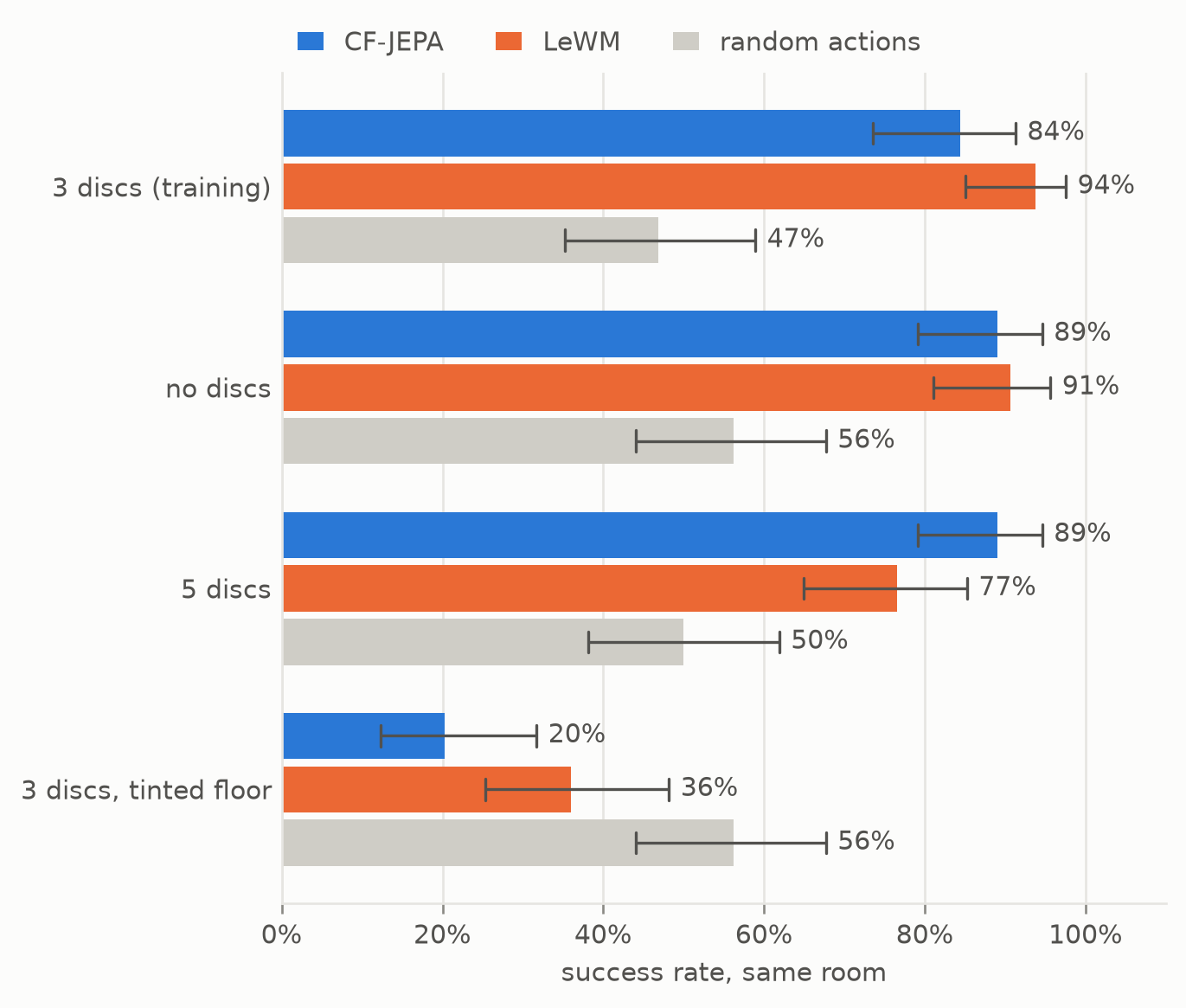
Across the door
Where do the episodes toward the other room go? Paths of the first 8 tasks in the training setting, and, per model, the share of episodes that end in the goal's room and the share that end against the wall (within 0.1 of it, on the start side).
key = ("3 discs (training)", "other room")
goal = goals[key].cpu()
for name in models:
    final = results[key].paths[name][:, -1].cpu()
    in_goal_room = (final[:, 0] > 0.5) == (goal[:, 0] > 0.5)
    at_wall = ~in_goal_room & ((final[:, 0] - 0.5).abs() < 0.1)
    print(f"{name:8s} ends in the goal's room {in_goal_room.float().mean():5.0%}, against the wall {at_wall.float().mean():5.0%}")
display(plots.trajectories(results[key].paths[name][:8].cpu(), goal[:8]))CF-JEPA ends in the goal's room 16%, against the wall 27%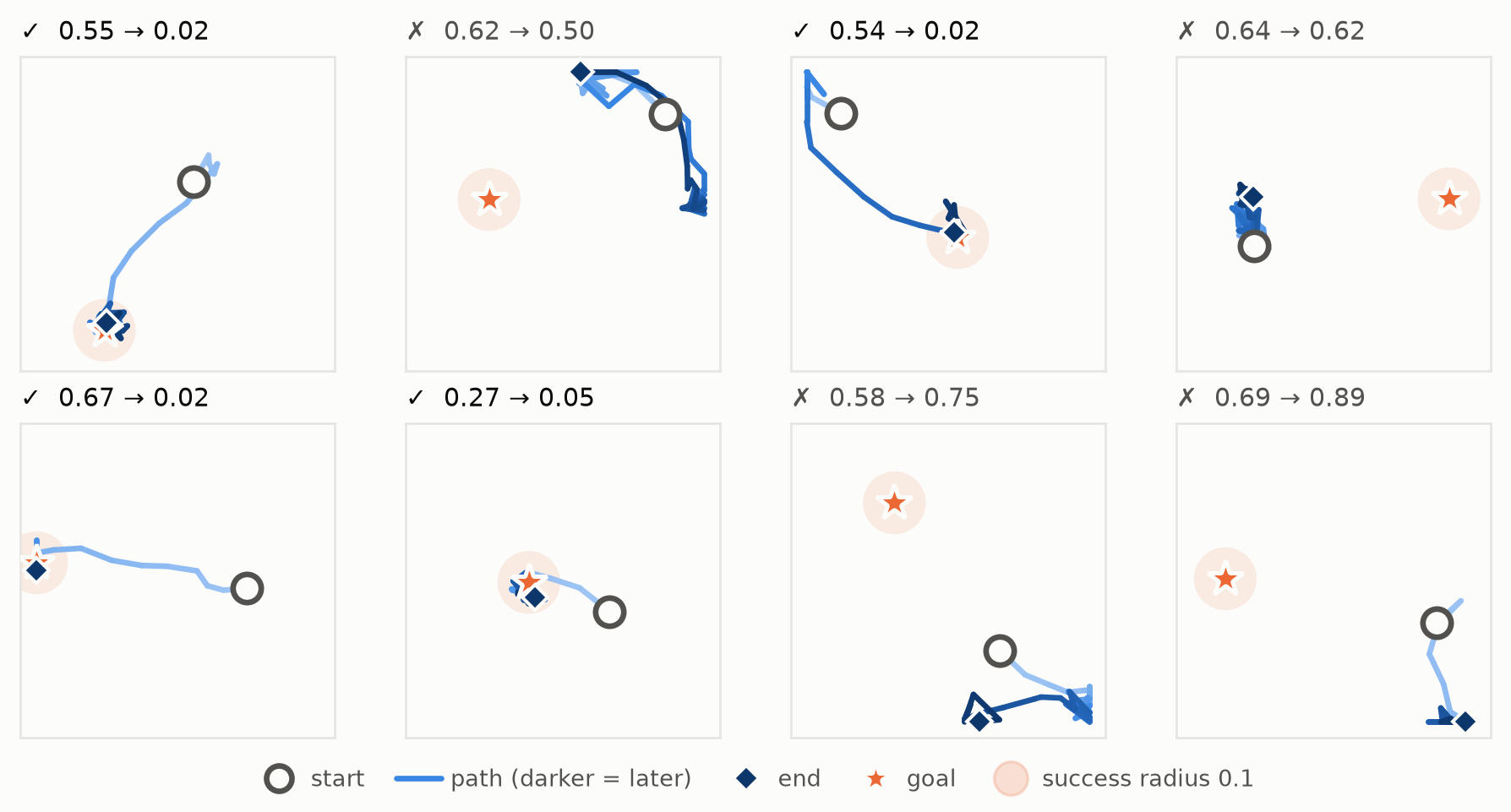
LeWM ends in the goal's room 41%, against the wall 19%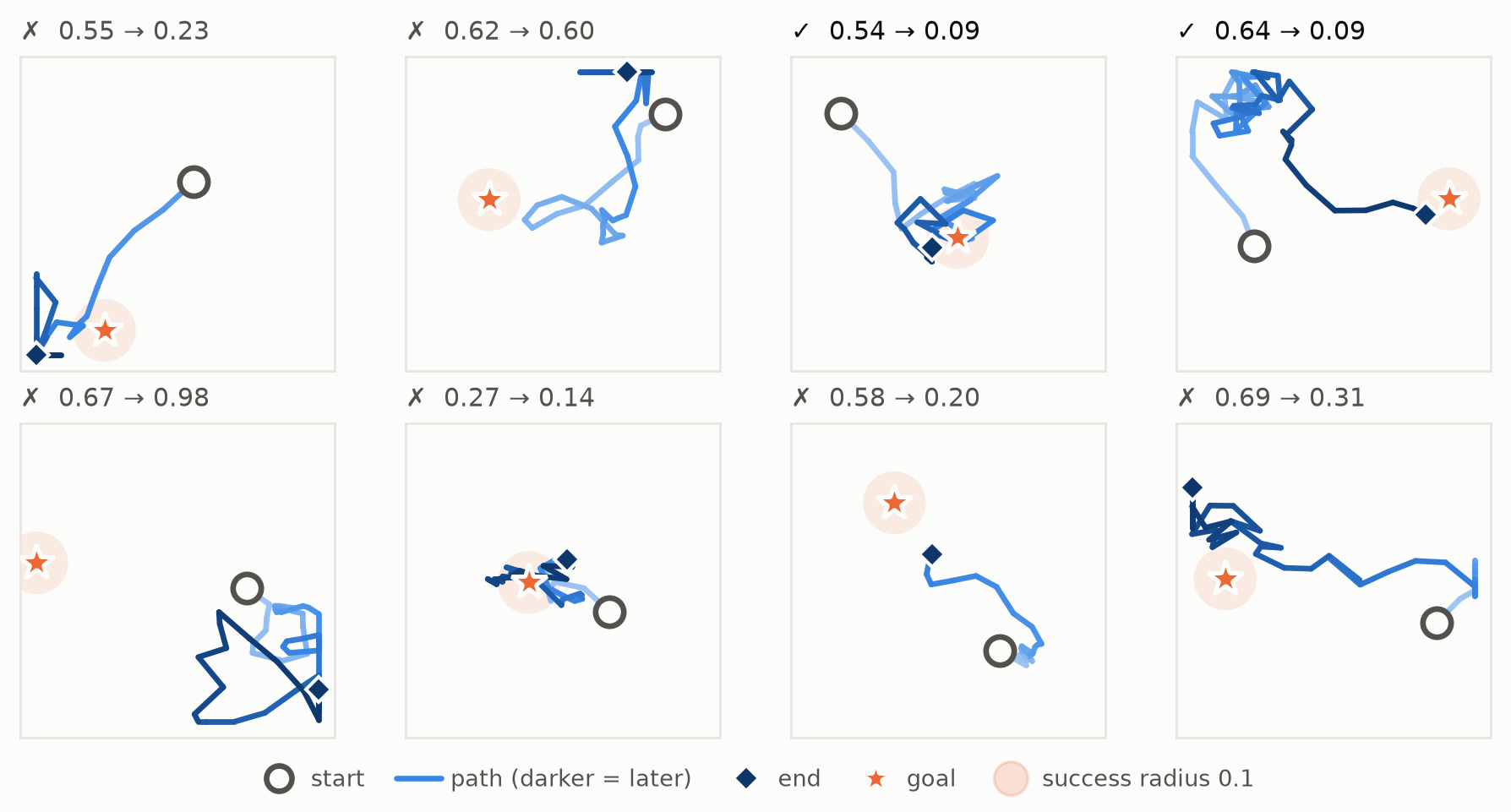
Summary
Success with its 95% Wilson interval, per setting and task:
names = [*models, "random actions"]
print(f"{'':36s}" + "".join(f"{n:>20s}" for n in names))
for (setting, task), result in results.items():
    rates = result.intervals()
print(f"{setting + ', ' + task:36s}" + "".join(f"{rates[n]!s:>20}" for n in names)) CF-JEPA LeWM random actions
3 discs (training), same room 84% [74%, 91%] 94% [85%, 98%] 47% [35%, 59%]
3 discs (training), other room 16% [9%, 26%] 44% [32%, 56%] 5% [2%, 13%]
no discs, same room 89% [79%, 95%] 91% [81%, 96%] 56% [44%, 68%]
no discs, other room 11% [5%, 21%] 17% [10%, 28%] 16% [9%, 26%]
5 discs, same room 89% [79%, 95%] 77% [65%, 85%] 50% [38%, 62%]
5 discs, other room 25% [16%, 37%] 41% [29%, 53%] 8% [3%, 17%]
3 discs, tinted floor, same room 20% [12%, 32%] 36% [25%, 48%] 56% [44%, 68%]
3 discs, tinted floor, other room 2% [0%, 8%] 3% [1%, 11%] 5% [2%, 13%]The factorization works as a representation. The discs account for 21% of the variance of CF-JEPA's controllable part, against 62% of LeWM's embedding, and the uncontrollable part takes most of them (83%). It pays off in planning when the distractors are new: with five discs, two in colors never seen, CF-JEPA reaches 89% [79, 95] of the same-room goals and LeWM 77% [65, 85].
Elsewhere CF-JEPA does not beat LeWM. In the training setting LeWM is ahead in the same room (94% against 84%, overlapping intervals) and clearly ahead toward the other room (44% against 16%). LeWM's successful episodes there are long (28 steps to the goal on average, against 10 for CF-JEPA): the drifting discs keep moving its cost, and the wandering that results takes it through the door more often. Without discs its other-room success falls to 17%, the level of random actions. CF-JEPA plans steadily toward a goal that greedy planning cannot reach: 84% of its episodes end in the start room, 27% against the wall. An 8-step CEM on a latent distance does not find the door reliably for either model. The paper's 95% on Two-Room comes with 14 times more data (920k frames against 67k here), 224-pixel images and larger distractors, which hurt its LeWM much more (33%) than the small discs hurt ours.
The tinted floor breaks both models, which fall below random actions: CF-JEPA factors out what moves on its own, not a change in appearance it never saw in training. A previous run of this notebook differed by a few points per row (GPU nondeterminism and the discs' unseeded motion) with the same pattern, so differences inside the intervals are noise.