
MyoSuite with a TD-MPC2 baseline

MyoSuite drives musculoskeletal models with muscle activations. Here the task is myoFingerReachRandom-v0: bring a fingertip, driven by five muscles, to a target sampled at every reset. Rewards are MyoSuite's dense rewards, and an episode succeeds if MyoSuite's solved flag is raised at any step.
The baseline is TD-MPC2, the model these suites were benchmarked with: an encoder, latent dynamics, a reward head, an ensemble of Q-functions and a policy prior, learned online from what the agent collects, with no decoder. MPPI searches action sequences in its latent space. This is a deliberately small run: a 128-dimensional latent, state observations and 20,000 updates, not the paper's millions.
import importlib.util

if importlib.util.find_spec("torch_world") is None:  # on Colab
%pip install -q "torch-world[examples,myosuite]"import time
import torch
from torch_world import plots
from torch_world.envs import MyoSuite
from torch_world.models import TDMPC2
from torch_world.models.tdmpc import state_encoder
from torch_world.planning import MPPI
torch.manual_seed(0)
device = "cuda" if torch.cuda.is_available() else "cpu"
TASK, ENVS, HORIZON = "myoFingerReachRandom-v0", 16, 3
world = MyoSuite(TASK, batch_size=ENVS, terminate_on_success=False, render_size=128)
EPISODE, A, D = world.max_episode_steps, world.action_dim, world.state.shape[-1]
print(f"{EPISODE}-step episodes, {D} state dimensions, {A} actions")100-step episodes, 19 state dimensions, 5 actionsThe task
MyoSuite needs MuJoCo 3.7 or later, so it is installed apart from the benchmark extra. Episodes run to the time limit, as in TD-MPC2's own evaluations, instead of ending at success: the rewards are dense and highest near the goal, so ending the episode there would cut off the reward a return-maximizing planner is after. 16 episodes run in parallel, one per batch lane; each lane is seeded separately. The first frames of four lanes:
world.reset(seed=0)
plots.images(world.render_frame()[:4], [f"lane {i}" for i in range(4)], ncols=4, size=2.2)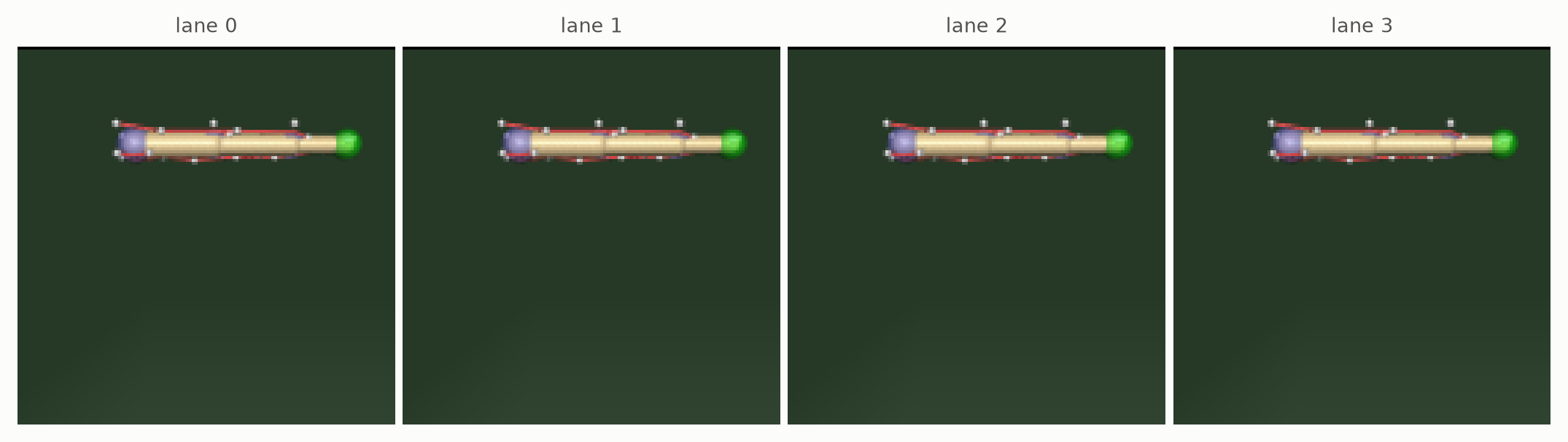
Model and planner
A small TD-MPC2: 128-dimensional SimNorm latents, 256-unit MLPs and the paper's five Q-functions, with the reference's discount for this episode length. MPPI plans 3 steps ahead with 256 sequences, 12 of them proposed by the policy prior, and starts each call from the previous plan shifted by one step.
model = TDMPC2(
    state_encoder(D, latent_dim=128, hidden_dim=256), action_dim=A, latent_dim=128, mlp_dim=256,
    discount=TDMPC2.episode_discount(EPISODE), episodic=False,
).to(device)
opt = torch.optim.Adam(model.param_groups(3e-4))
planner = MPPI(horizon=HORIZON, action_dim=A, num_samples=256, num_elites=32, num_pi_trajs=12, iterations=4)
print(f"{sum(p.numel() for p in model.parameters() if p.requires_grad) / 1e6:.2f}M parameters, discount {model.discount:.3f}")1.04M parameters, discount 0.950Online training
Each round collects 16 episodes in parallel, then takes 500 gradient steps on windows of HORIZON + 1 steps from all episodes so far. Windows never cross the end of an episode: a lane that finished is padding, valid=False, until the next reset. The first round acts at random; after that, MPPI acts, with exploration noise from its own final std.
buffer = {k: [] for k in ("obs", "actions", "rewards", "terminated", "valid")}


def collect(policy, seed, frames=0):
    """Run one episode per lane; store it, and return its return, success and the first lanes' frames."""
    obs = world.reset(seed=seed)
    planner.reset()
    data = {k: [] for k in buffer}
    data["obs"].append(obs)
    returns, success = torch.zeros(ENVS), torch.zeros(ENVS, dtype=torch.bool)
    video = [world.render_frame()[:frames]] if frames else []
    while not world.transition.done.all():
        active = ~world.transition.done
        action = policy(obs)
        obs = world.step(action)
        t = world.transition
        for key, value in zip(data, (obs, action, t.reward, t.terminated & active, active)):
            data[key].append(value)
        returns += t.reward * active
        if t.success is not None:
            success |= t.success
        if frames:
            video.append(world.render_frame()[:frames])
    for key in buffer:  # pad to a full episode, invalid, when every lane ended early
        x = torch.stack(data[key], 1)
        pad = torch.zeros_like(x[:, :1]).expand(-1, EPISODE + (key == "obs") - x.size(1), *x.shape[2:])
        buffer[key].append(torch.cat([x, pad], 1))
    return returns, success, torch.stack(video, 1) if frames else None


def sample(n):
    """Windows of HORIZON + 1 observations whose HORIZON steps are all valid."""
    obs, actions, rewards, terminated, valid = (torch.cat(buffer[k]) for k in buffer)
    starts = valid[:, HORIZON - 1 :].nonzero()  # valid through t + HORIZON - 1, so valid from t
    pick = starts[torch.randint(len(starts), (n,))]
    episode, t = pick[:, :1], pick[:, 1:] + torch.arange(HORIZON + 1)
    steps = t[:, :-1]
    batch = obs[episode, t], actions[episode, steps], rewards[episode, steps], terminated[episode, steps]
    return [x.to(device) for x in batch]


def act(obs, explore=True):
    return planner(model, model.encode(obs.to(device)[:, None]), explore=explore)[:, 0].cpu()


def random_policy(obs):
    return torch.rand(ENVS, A) * 2 - 1


log = {k: [] for k in ("consistency_loss", "reward_loss", "value_loss", "pi_loss")}
history, tic = [], time.perf_counter()
returns, success, _ = collect(random_policy, seed=0)
history.append((returns.mean().item(), success.float().mean().item()))
for round in range(40):
    model.train()
    for _ in range(500):
        out = model(*sample(256))
        opt.zero_grad()
        out["loss"].backward()
        model.clip_grad_norm(20.0)
        opt.step()
        model.update_target(0.99)
        for key in log:
            log[key].append(out[key].item())
    model.eval()
    with torch.no_grad():
        returns, success, _ = collect(act, seed=(round + 1) * ENVS)
    history.append((returns.mean().item(), success.float().mean().item()))
    if round % 4 == 0 or round == 39:
        print(f"round {round:3d}  return {history[-1][0]:7.1f}  success {history[-1][1]:.2f}  {(time.perf_counter() - tic) / 60:5.1f} min")
plots.curves(log, smooth=100)round 0 return -9.7 success 0.12 0.3 minround 4 return 379.8 success 1.00 1.9 minround 8 return 466.6 success 1.00 3.3 minround 12 return 637.6 success 1.00 5.0 minround 16 return 799.0 success 1.00 6.4 minround 20 return 796.7 success 1.00 8.1 minround 24 return 798.7 success 1.00 9.9 minround 28 return 796.6 success 1.00 11.9 minround 32 return 799.2 success 1.00 13.9 minround 36 return 799.1 success 1.00 17.0 minround 39 return 798.0 success 1.00 19.3 min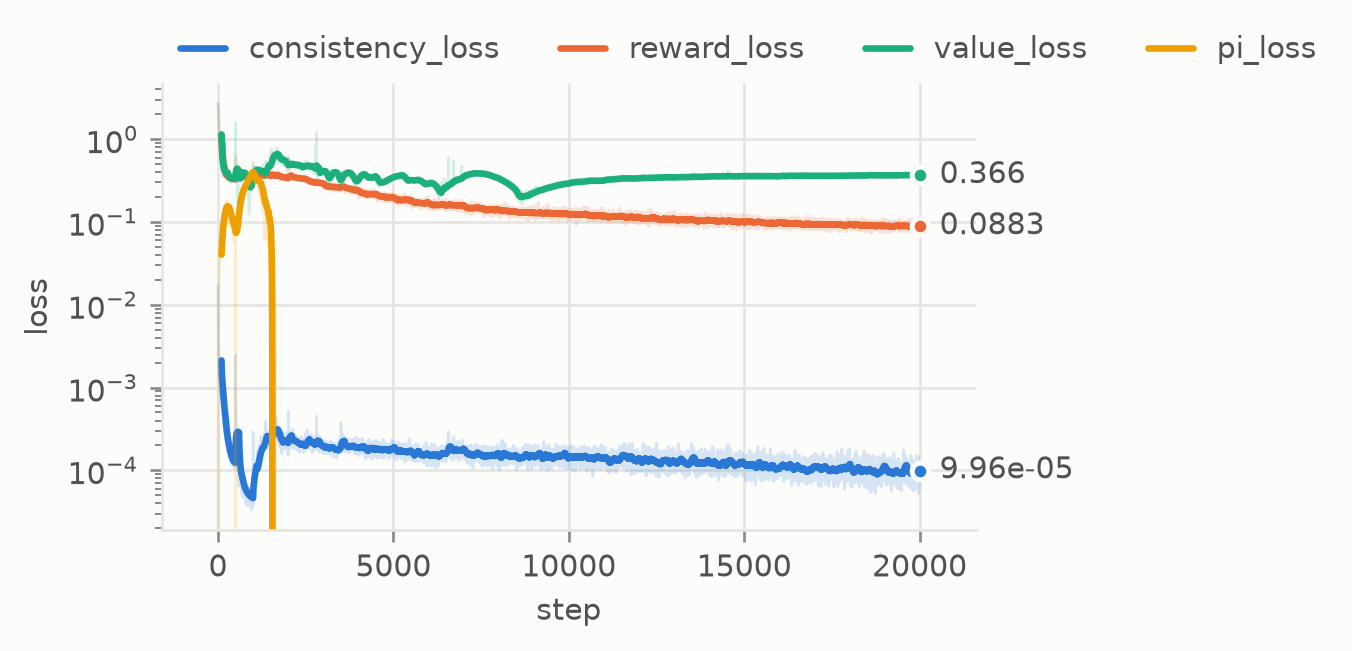
rounds = list(range(len(history)))
plots.curves({"episode return": (rounds, [h[0] for h in history])}, smooth=3, logy=False, ylabel="return per round")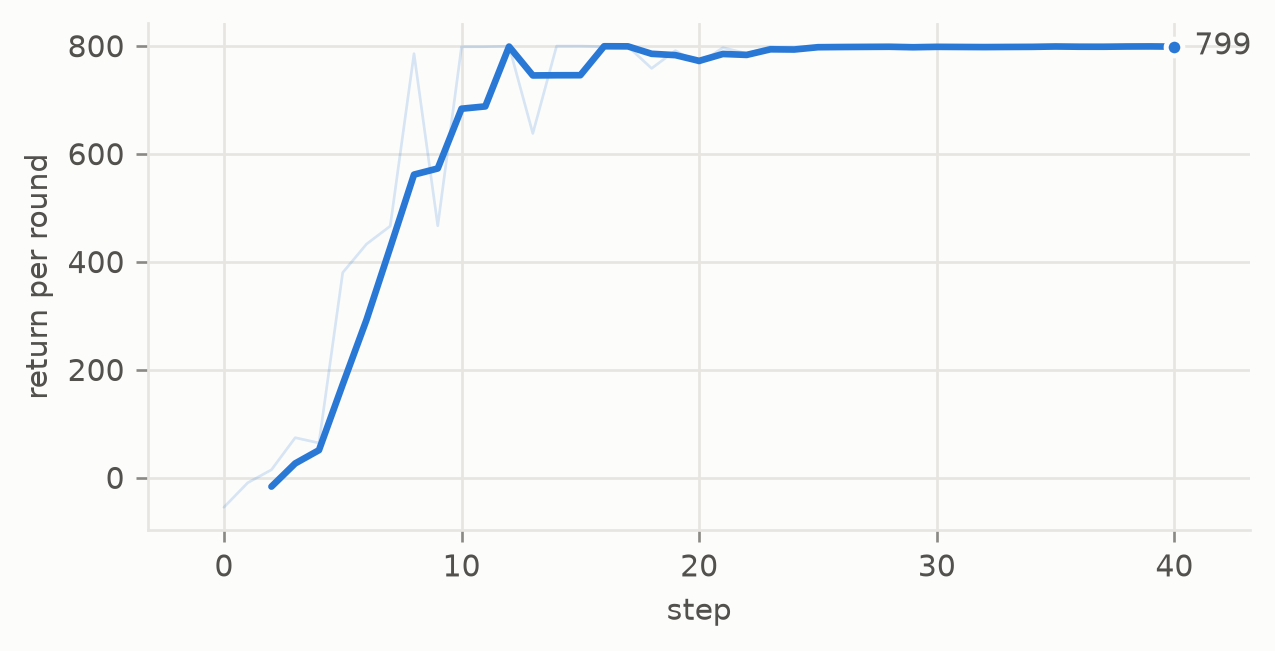
Evaluation
16 new seeded episodes for each of three policies: MPPI over the world model without exploration noise, the policy prior alone (its mean action, no search) and random actions.
def prior(obs):
    return model.pi(model.encode(obs.to(device)[:, None])[:, 0])[1]["mean"].cpu()


results, video = {}, None
with torch.no_grad():
    for name, policy in (
        ("TD-MPC2 + MPPI", lambda obs: act(obs, explore=False)),
        ("policy prior", prior),
        ("random actions", random_policy),
    ):
        frames = 4 if name == "TD-MPC2 + MPPI" else 0
        returns, success, clip = collect(policy, seed=10_000, frames=frames)
        video = clip if frames else video
        results[name] = {"return": returns.mean().item(), "success": success.float().mean().item()}
        print(f"{name:15s} return {returns.mean():7.1f} ± {returns.std():5.1f}   success {success.float().mean():.2f}")
plots.bars({"success rate": {k: v["success"] for k, v in results.items()}}, xlabel="success rate", baseline="random actions")TD-MPC2 + MPPI return 799.2 ± 0.0 success 1.00policy prior return 799.4 ± 0.0 success 1.00
random actions return -55.4 ± 3.2 success 0.06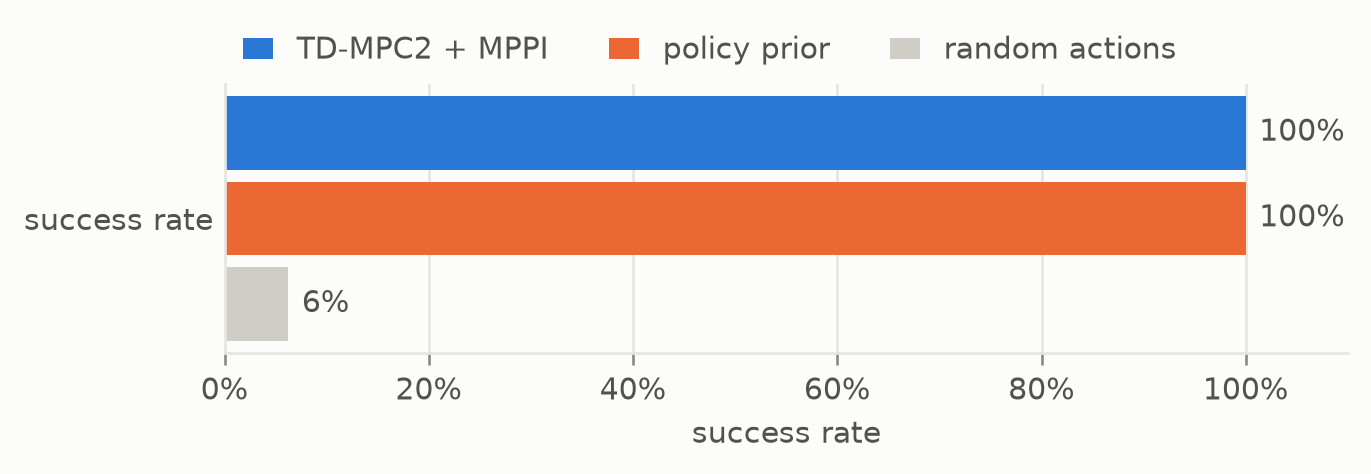
Four of the planned evaluation episodes.
step = max(video.size(1) // 60, 1)
plots.episodes(video[:, ::step], titles=[f"lane {i}" for i in range(4)], fps=8)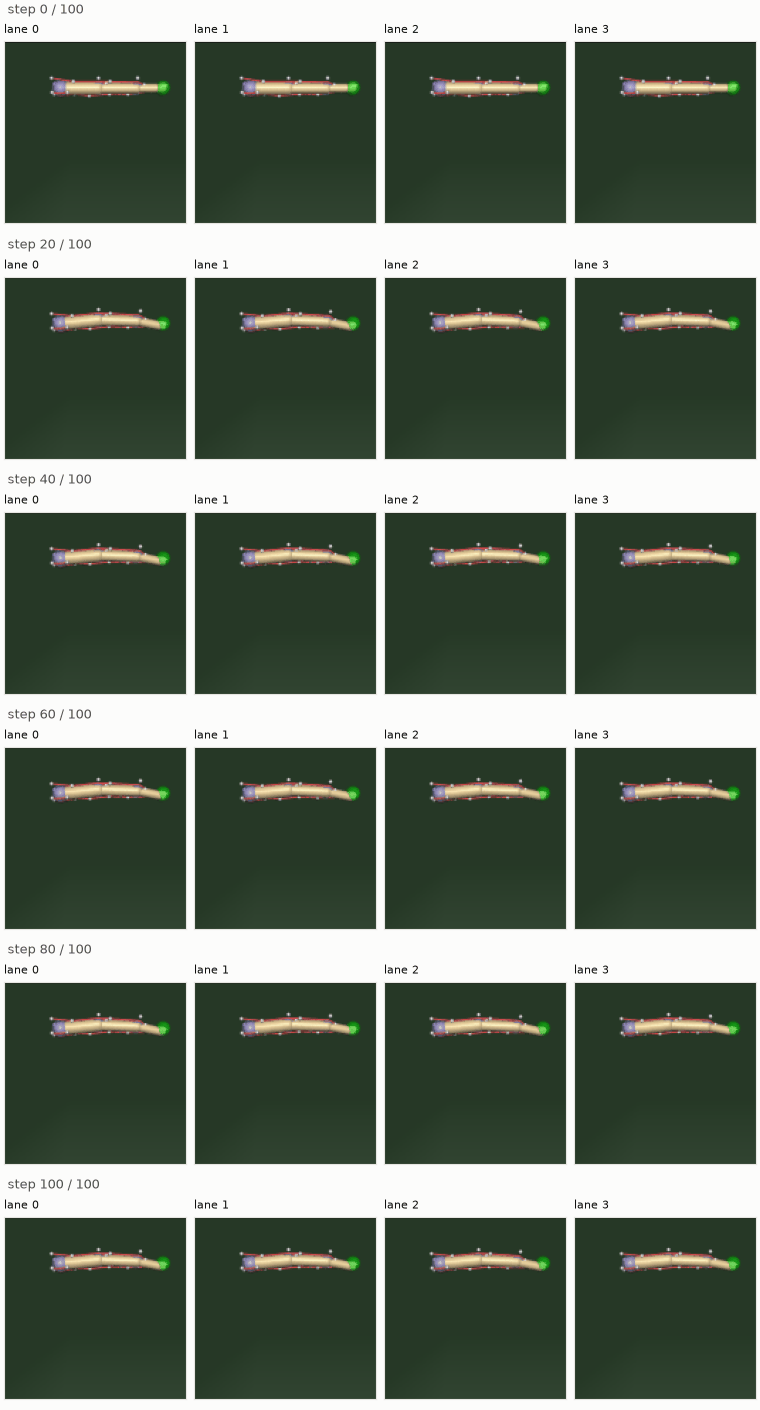
This is a small baseline. TD-MPC2's reference runs use a 512-dimensional latent, one update per environment step and up to millions of steps; observation="rgb" with pixel_encoder trains from images. Any other task works the same way: MyoSuite(name) takes the suite's own task names, and list_envs(backend="myosuite") lists the registered ones.