
PickPlace-v0

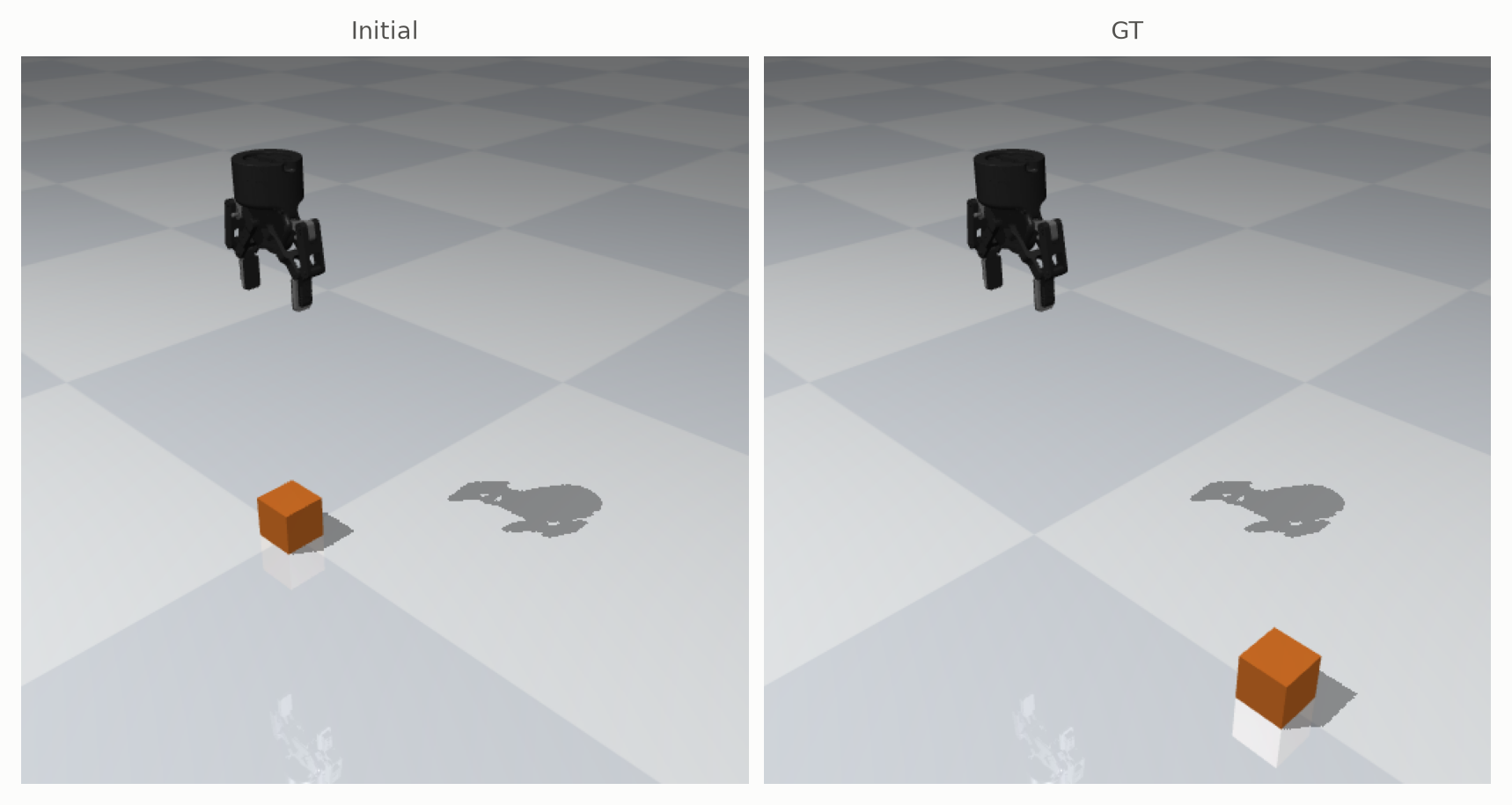
Grasp and relocate a 60 mm cube with a Robotiq 2F-85 on a Cartesian stage. Our MuJoCo task uses an articulated, tendon-driven gripper with contact-only grasping. Four normalized controls command X, Y, Z, and gripper closure (−1 open, +1 closed). Success requires a settled cube at GT, open fingers, and a withdrawn gripper.
mujoco · Hardware model and license.
A small LeWM baseline experiment: held-out dynamics prediction, a persistence control, and closed-loop planning against random actions. This validates the experiment pipeline; it is not a paper-scale training run.
import importlib.util

if importlib.util.find_spec("torch_world") is None:  # on Colab
%pip install -q "torch-world[examples,benchmark]"from pathlib import Path
from torch_world.benchmarks import observation_encoder, run_experiment, show_results
from torch_world.envs import PickPlace
from torch_world.models import LeWM
from torch_world.planning import CEMProtocol
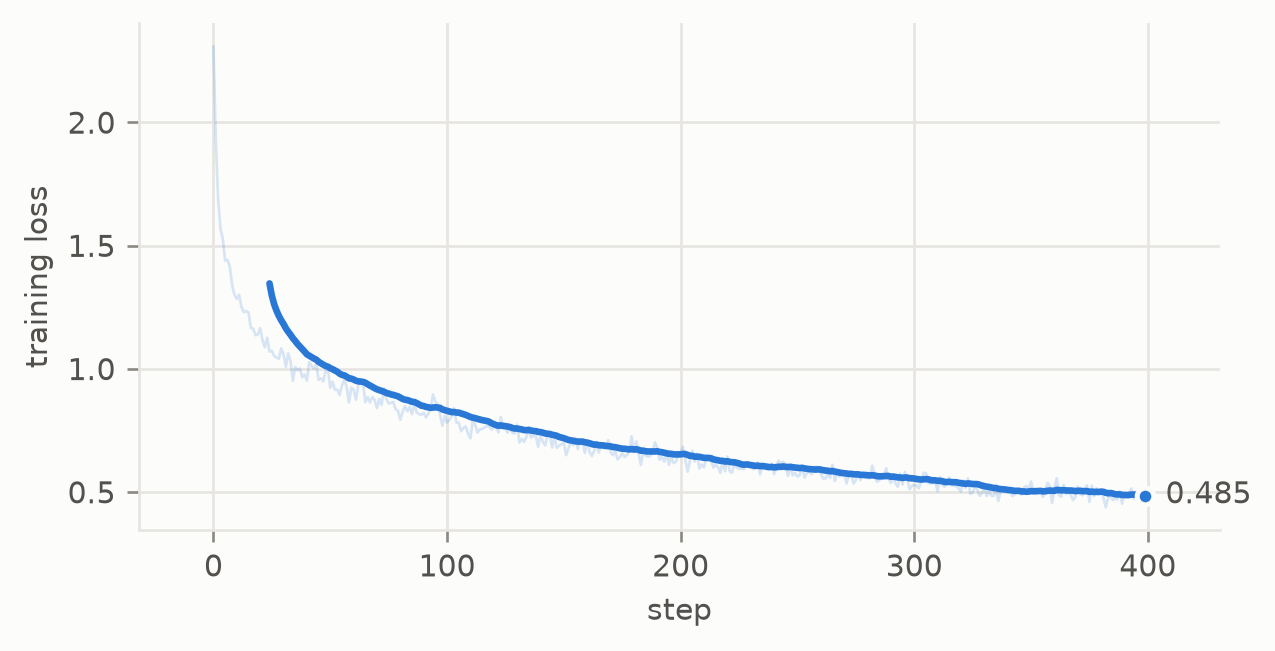
2,048 requested training pairs; 400 updates; four evaluation seeds; 60-step evaluation budget. Puzzle training and holdout use disjoint starting states. Other tasks use separate collection seeds. Goal-renderable tasks use goal-image MPC; others learn a reward head on frozen embeddings and plan predicted rewards. Actual simulator returns are scored. The one-step model protocol uses history=1.
Rendering defaults to high quality: 128-pixel model inputs and 512-pixel presentation frames. Use quality="low" or quality="medium" to compare cost and quality; size and render_size can be set independently.
Fixed puzzle layouts use the same start for all four planner seeds. Success intervals therefore describe policy randomness on that level, not generalization across levels.
world = PickPlace(quality="high")
SEED, UPDATES = 7, 400
OUTPUT_DIR = Path('../runs/benchmarks/20261015_robotiq_2f85')

# Replace this factory to compare another WorldModel with the same experiment.
def model_factory(observation_shape, action_dim):
    return LeWM(
        observation_encoder(observation_shape), action_dim, embed_dim=32, history=1,
        depth=2, num_heads=4, head_dim=8, mlp_dim=64, proj_dim=64, dropout=0,
    )


def planner_factory(action_dim):
return CEM(8, action_dim, num_samples=96, num_elites=12, iterations=3, bounds=(-1, 1))world.show_env()PickPlace-v0 · mujoco — Grasp and relocate a free cube with a Robotiq 2F-85. 4 normalized action components in [-1, 1].
result = run_experiment(
    world, model_factory=model_factory, planner_factory=planner_factory,
    seed=SEED, updates=UPDATES, output_dir=OUTPUT_DIR,
)
GT reference
A verified successful episode GIF, separate from the model results. The GT panel remains visible throughout. Reference controllers may use a longer episode budget than model evaluation; the GIF shows actual simulator step numbers.
world.show_success()PickPlace-v0 — verified reference episode · 249 simulator steps; separate from model evaluation.
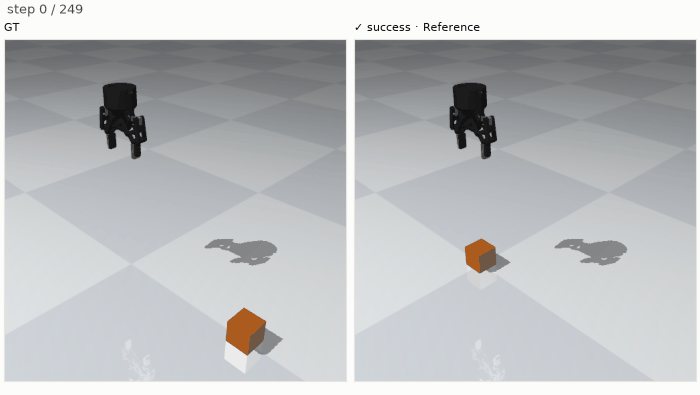
Static preview of the recorded episode. Rerun this cell to view the animation.
Results
Lower prediction error alone does not establish planning competence.
show_results(result)
print("Saved run:", result["run_dir"])
PickPlace-v0 · LeWM — pixels observations, seed 7, 400 updates, 2,048 training / 512 held-out pairs. cuda; 49.1 s.
| Prediction method | Held-out latent MSE ↓ |
|---|---|
| LeWM | 1.1892 |
| Persistence | 0.3921 |
Latent standard deviation: 0.659. Latent errors are comparable within this model; their scale differs between models.
| Policy | Success | Steps | Final distance ↓ |
|---|---|---|---|
| LeWM + CEM | 0% [0%, 49%] | 60.0 | 7.697 |
| random | 0% [0%, 49%] | 60.0 | 7.697 |
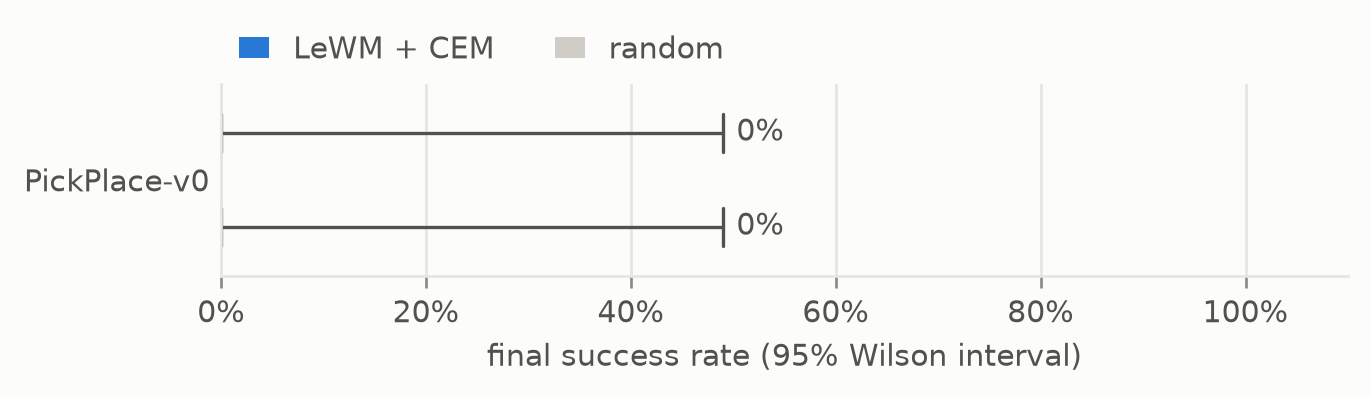
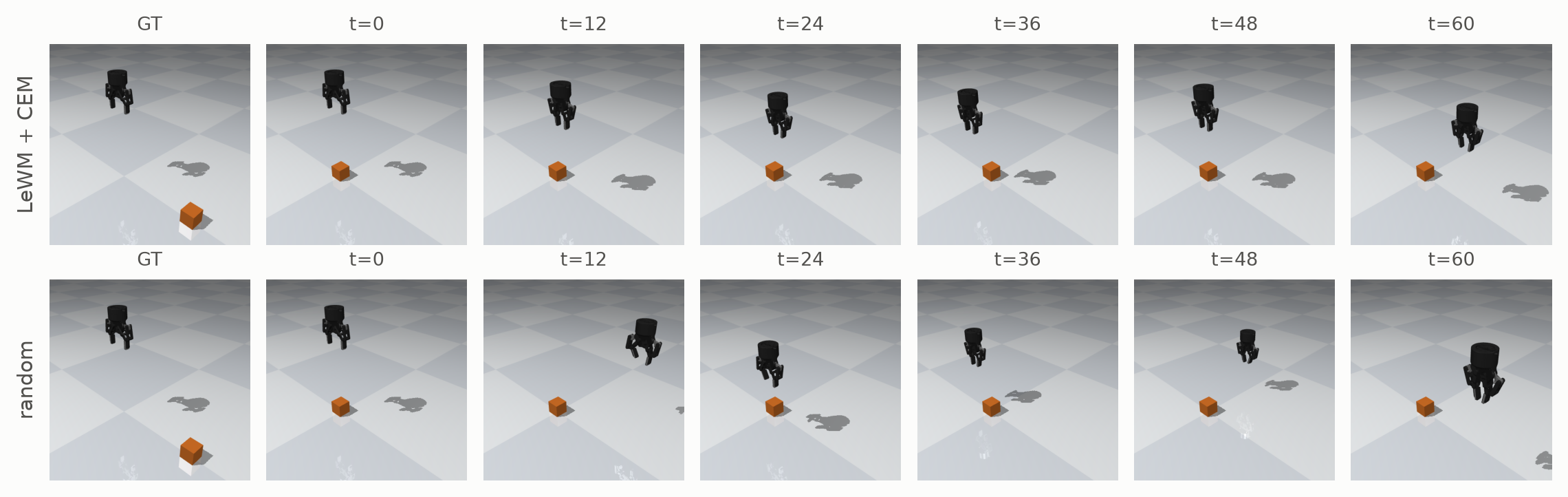
First evaluation seed shown; both policies start from the same state. All seeds are scored above.
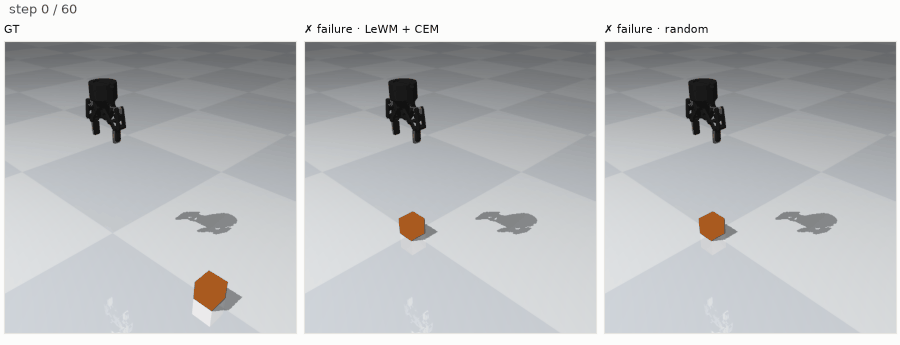
Static preview of the recorded episode. Rerun this cell to view the animation.
Saved run: runs/benchmarks/20261015_robotiq_2f85/PickPlace-v0/LeWM/20261015T160809365579Z-4b68540bworld.close()