
LeJEPA: self-supervised learning without the heuristics
INFO
本页尚未翻译。 阅读英文版

LeJEPA (code) uses no teacher network, stop-gradient or schedule. Every view's embedding predicts the mean embedding of the global views. SIGReg (Sketched Isotropic Gaussian Regularization) prevents collapse by pushing random 1D projections of the embeddings toward a standard normal.
python
import importlib.util

if importlib.util.find_spec("torch_world") is None:  # on Colab
    %pip install -q "torch-world[examples]"
python
import torch
import torch.nn.functional as F
from torch import nn

from torch_world import metrics, plots
from torch_world.envs import PointMass
from torch_world.models import LeJEPA
from torch_world.nn import MLP, CLSEncoder
from torch_world.utils import recompute_batchnorm

torch.manual_seed(0)
device = "cuda" if torch.cuda.is_available() else "cpu"
Views
Two global crops (30-100% of the image) and four local crops (5-30%) per image.
python
def crop(images, scale, size):
    s = torch.empty(1).uniform_(*scale).sqrt().item()
    n = max(2, int(images.size(-1) * s))
    i, j = torch.randint(0, images.size(-1) - n + 1, (2,)).tolist()
    return F.interpolate(images[..., i : i + n, j : j + n], size=size, mode="bilinear", antialias=True)


def views(images):
    return [crop(images, (0.3, 1.0), 32) for _ in range(2)] + [crop(images, (0.05, 0.3), 16) for _ in range(4)]


env = PointMass(batch_size=256, size=32, device=device)
images = env.reset()
plots.images(torch.stack([F.interpolate(v[:1], size=32)[0] for v in views(images)]), ["global", "global"] + ["local"] * 4, ncols=6)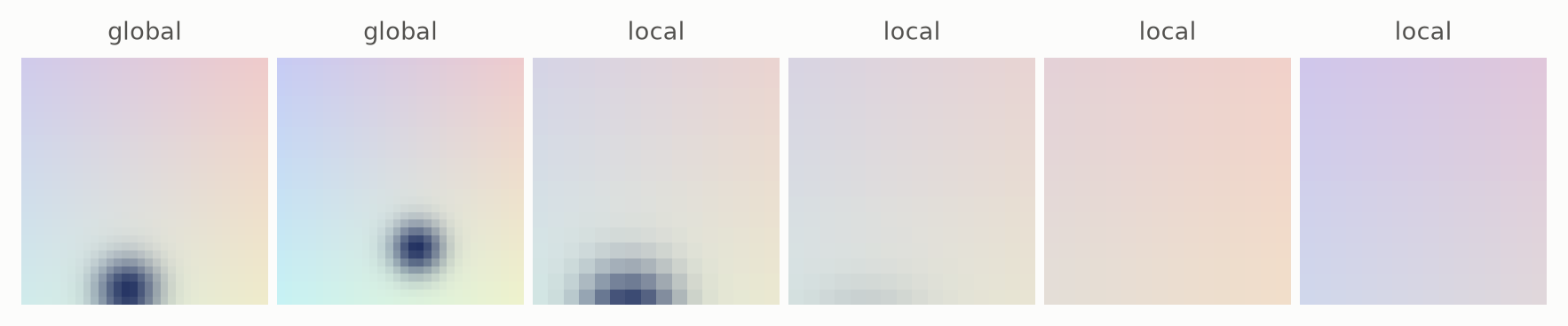
Train
python
model = LeJEPA(CLSEncoder(32, 4, embed_dim=192, depth=6, num_heads=6, resize=True), MLP([192, 512, 512, 64], norm=nn.BatchNorm1d), lamb=0.05).to(device)
opt = torch.optim.AdamW(model.parameters(), lr=5e-4, weight_decay=5e-2)

log = {"prediction": [], "SIGReg": []}
for step in range(1500):
    out = model(views(env.reset()), num_global=2)
    opt.zero_grad()
    out["loss"].backward()
    opt.step()
    log["prediction"].append(out["pred_loss"].item())
    log["SIGReg"].append(out["sigreg_loss"].item())

plots.curves(log)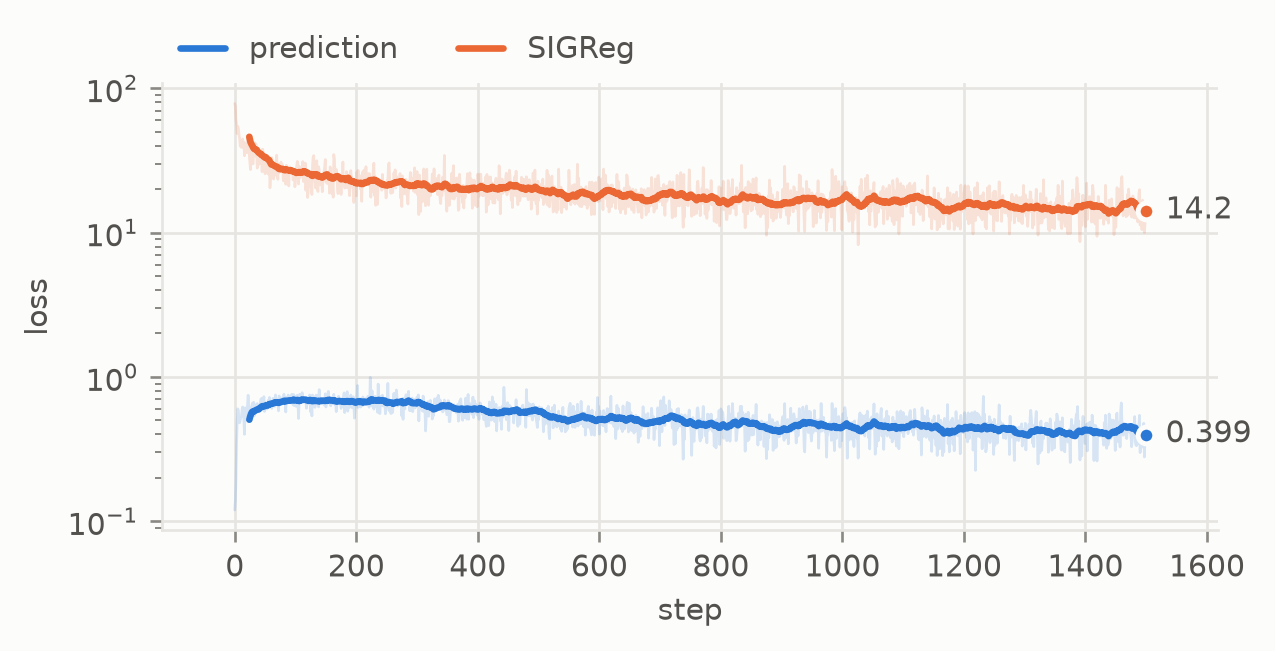
The embeddings are isotropic Gaussian
Project the embeddings of fresh images on random unit directions. Under SIGReg every projection should match a standard normal.
python
recompute_batchnorm(model, [PointMass(batch_size=256, size=32, device=device).reset() for _ in range(16)], lambda x: model.projector(model.encoder(x)))
model.eval()
with torch.no_grad():
    z = model.projector(model.encoder(PointMass(batch_size=4096, size=32, device=device).reset()))
directions = F.normalize(torch.randn(z.size(1), 3, device=device), dim=0)
projections = (z @ directions).cpu()

with plots.style() as plt:
    fig, axes = plt.subplots(1, 3, figsize=(7.2, 2.2), sharey=True, layout="constrained")
    grid = torch.linspace(-4, 4, 200)
    for i, ax in enumerate(axes):
        ax.hist(projections[:, i], bins=60, range=(-4, 4), density=True, color=plots.SERIES[0], alpha=0.35, lw=0)
        ax.plot(grid, torch.exp(-grid**2 / 2) / (2 * torch.pi) ** 0.5, color=plots.INK_2, lw=1.2)
        ax.set(title=f"direction {i + 1}", xlabel="projection")
    axes[0].set_ylabel("density")
    plt.close(fig)
fig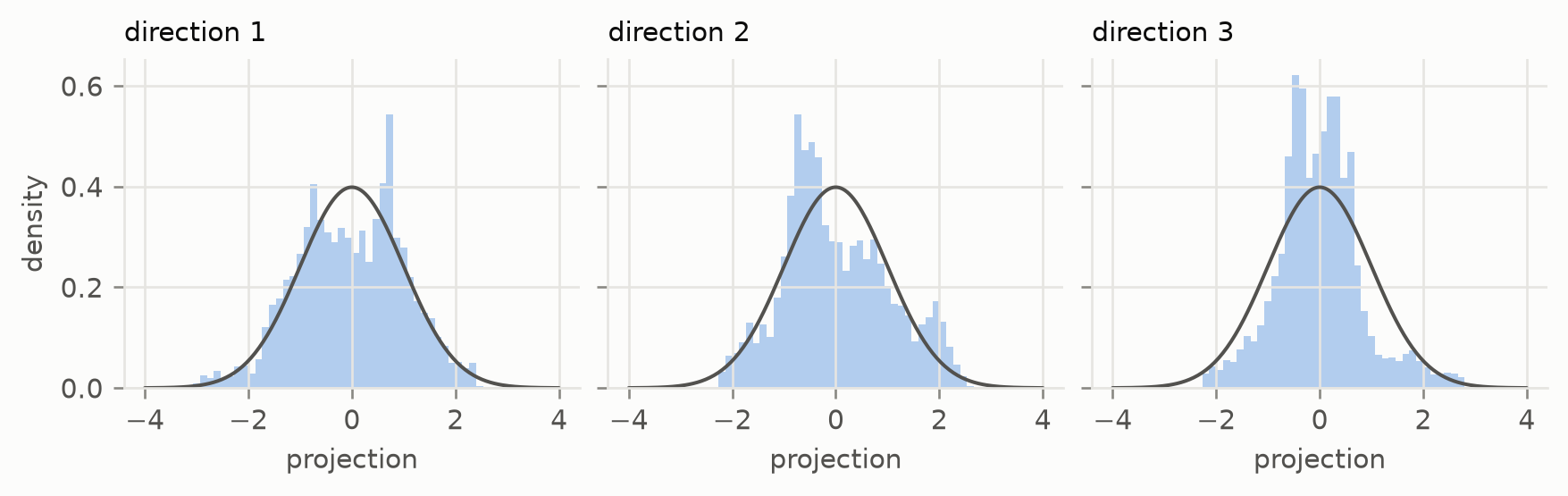
How good are the embeddings?
LeJEPA is evaluated on the frozen backbone (the encoder before the projector). Three metrics on 2048 fresh images, against the same encoder at random initialization:
- linear probe: regresses the position of the point, fit on 1536 images and scored by R² on 512;
- RankMe: the effective rank of the embeddings, out of 192 dimensions;
- LiDAR: the effective rank of the embeddings after whitening by their spread across 4 global crops of the same image, so only directions that tell images apart count. It was designed to predict linear-probe quality in JEPAs.
python
env = PointMass(batch_size=2048, size=32, device=device)
images = env.reset(generator=torch.Generator().manual_seed(7))
position = env.state

baseline = CLSEncoder(32, 4, embed_dim=192, depth=6, num_heads=6, resize=True).to(device).eval()
print(f"{'':12s}{'linear probe R²':>17s}{'RankMe':>9s}{'LiDAR':>8s}")
for name, net in {"random init": baseline, "LeJEPA": model.encoder}.items():
    with torch.no_grad():
        z = net(images)
        crops = torch.stack([net(crop(images, (0.3, 1.0), 32)) for _ in range(4)], 1)
    linear = metrics.linear_probe(z[:1536], position[:1536], z[1536:], position[1536:])
    print(f"{name:12s}{linear.score:17.3f}{metrics.rankme(z):9.1f}{metrics.lidar(crops):8.1f}")
text
linear probe R² RankMe LiDARtext
random init 0.993 1.1 6.3text
LeJEPA 0.993 1.8 10.5