
OGBench with a RoboJEPA baseline
INFO
Esta página aún no está traducida. Leer en inglés

OGBench is an offline goal-conditioned benchmark: a world model trains on a fixed dataset of play data, then reaches goals it has never been shown. Here the task is visual-cube-single-play-v0, a UR5e arm that must move a cube to a goal pose seen only as a 64 × 64 goal image, across OGBench's five evaluation tasks.
The baseline is RoboJEPA in its simplest form: one camera, no proprioception, and raw 8 × 8 pixel patches in place of the frozen V-JEPA 2.1 encoder. It trains on chunks of five actions, as DINO-WM does on OGBench, and plans with CEM toward the embedding of the goal image.
import importlib.util

if importlib.util.find_spec("torch_world") is None:  # on Colab
%pip install -q "torch-world[examples,ogbench]"import time
import torch
import torch.nn.functional as F
from torch import nn
from torch.utils.data import DataLoader
from torch_world import plots
from torch_world.datasets import TrajectoryDataset, load_ogbench
from torch_world.envs import OGBench
from torch_world.models import RoboJEPA
from torch_world.planning import CEM, RecedingHorizon
torch.manual_seed(0)
device = "cuda" if torch.cuda.is_available() else "cpu"
amp = torch.autocast(device, dtype=torch.bfloat16) # matmuls in bf16; losses and planner statistics stay float32
NAME = "visual-cube-single-play-v0"
FRAMESKIP, WINDOW, GRID = 5, 4, (8, 8)Data
load_ogbench downloads the dataset once into ~/.ogbench/data and stacks it into episodes (N, T, ...); images stay uint8 to save memory. Each training window holds four frames five steps apart, and each of its steps the five actions that follow the frame.
train, val = load_ogbench(NAME), load_ogbench(NAME, split="val")
print({k: tuple(v.shape) for k, v in train.items()}, {k: tuple(v.shape) for k, v in val.items()})
loader = DataLoader(
    TrajectoryDataset(train, window=WINDOW, frameskip=FRAMESKIP), batch_size=64, shuffle=True, drop_last=True, num_workers=4
)
episode = train["observations"][0, : 8 * 25 : 25]
plots.images(episode, [f"t={25 * i}" for i in range(8)]){'observations': (1000, 1001, 3, 64, 64), 'actions': (1000, 1001, 5)} {'observations': (100, 1001, 3, 64, 64), 'actions': (100, 1001, 5)}
Model
The encoder cuts a frame into 64 patches of 8 × 8 pixels, so a timestep is 64 patch tokens and one action token.
class Patchify(nn.Module):
    def forward(self, x):
        return F.pixel_unshuffle(x, 8).flatten(2).transpose(1, 2)


def frames(observations):
    """Images ``(B, T, 3, H, W)``, uint8 or in [0, 1], as one camera view ``(B, T, 1, 3, H, W)`` in [0, 1]."""
    x = observations.float() / 255 if observations.dtype == torch.uint8 else observations
    return x.unsqueeze(2)


model = RoboJEPA(
    embed_dim=192, action_dim=5 * FRAMESKIP, num_views=1, predictor_dim=256, depth=6, num_heads=4,
    window=WINDOW, rollout_steps=2, encoder=Patchify(),
).to(device)
print(f"{sum(p.numel() for p in model.parameters()) / 1e6:.2f}M parameters")4.84M parametersTrain
STEPS = 15000
opt = torch.optim.AdamW(model.parameters(), lr=3e-4, weight_decay=0.04)
sched = torch.optim.lr_scheduler.OneCycleLR(opt, max_lr=3e-4, total_steps=STEPS, pct_start=0.05)
log, step, tic = {"teacher forcing": [], "rollout": []}, 0, time.perf_counter()
model.train()
while step < STEPS:
    for batch in loader:
        z = model.encode(frames(batch["observations"].to(device, non_blocking=True)), GRID)
        with amp:
            out = model(z, batch["actions"].to(device))
        opt.zero_grad(set_to_none=True)
        out["loss"].backward()
        opt.step()
        sched.step()
        log["teacher forcing"].append(out["tf_loss"].item())
        log["rollout"].append(out["rollout_loss"].item())
        step += 1
        if step == STEPS:
            break
model.eval()
print(f"{STEPS} updates in {(time.perf_counter() - tic) / 60:.1f} min")
plots.curves(log)15000 updates in 49.1 min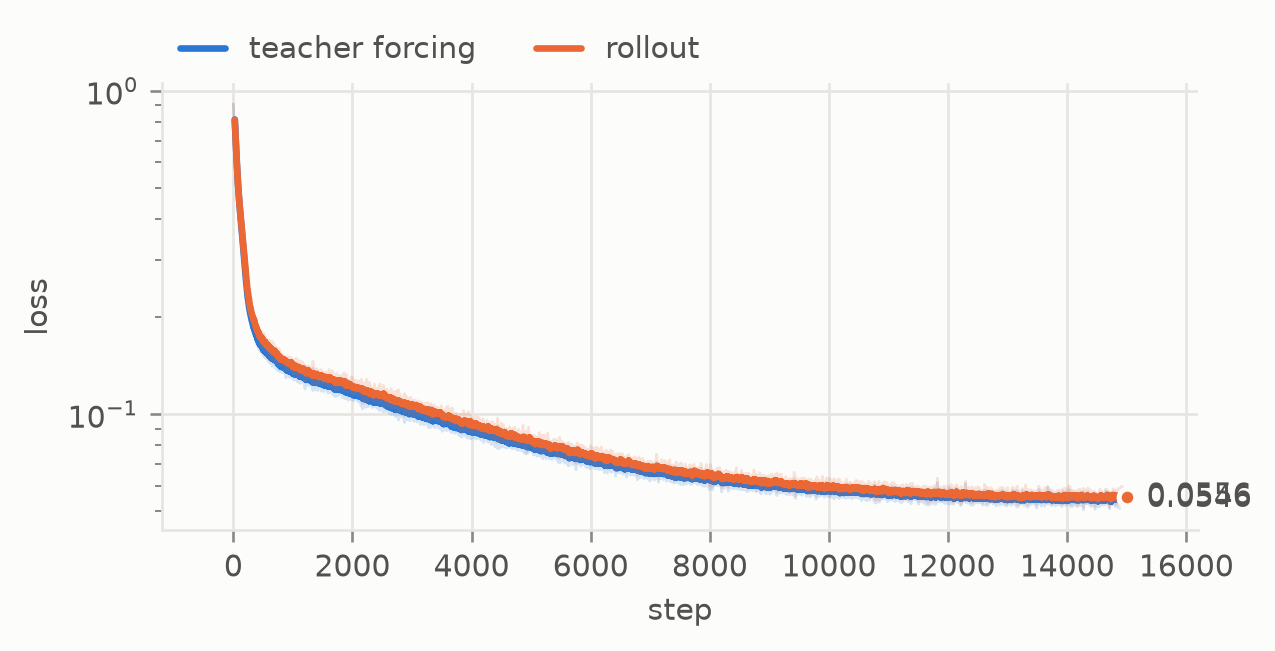
Held-out prediction
On the validation episodes, the model predicts the next latent of every window. Copying the last latent forward is the persistence baseline: a model that learned nothing about actions does no better than it.
val_windows = TrajectoryDataset(val, window=WINDOW, frameskip=FRAMESKIP)
idx = torch.randperm(len(val_windows), generator=torch.Generator().manual_seed(0))[:1024]
errors = {"RoboJEPA": [], "persistence": []}
with torch.no_grad():
    for chunk in idx.split(128):
        batch = [val_windows[i] for i in chunk.tolist()]
        obs = torch.stack([b["observations"] for b in batch]).to(device)
        actions = torch.stack([b["actions"] for b in batch]).to(device)
        z = model.encode(frames(obs), GRID)
        with amp:
            pred = model.predict(z[:, :-1], actions[:, :-1]).float()
        errors["RoboJEPA"].append((pred[:, -1] - z[:, -1]).abs().mean().item())
        errors["persistence"].append((z[:, -2] - z[:, -1]).abs().mean().item())
for name, e in errors.items():
print(f"{name:12s} next-latent L1 {sum(e) / len(e):.4f}")RoboJEPA next-latent L1 0.0545
persistence next-latent L1 0.1404Plan toward the goal image
CEM plans five chunks of five actions toward the encoded goal; the arm runs the first two chunks, then the planner looks again. Each of OGBench's five evaluation tasks runs eight seeded episodes, against random actions. Episodes end at success or after OGBench's 200 steps.
planner = CEM(horizon=5, action_dim=5 * FRAMESKIP, num_samples=128, num_elites=16, iterations=5, bounds=(-1, 1), objective="path")
EPISODES, results, videos = 8, {}, {}


def evaluate(task_id, kind):
    world = OGBench(NAME, task_id=task_id, batch_size=EPISODES, render_size=128)
    world.reset(seed=1000 + task_id)
    goal = model.encode(frames(world.goal[:, None].to(device)), GRID)[:, 0]

    def plan(obs):
        z = model.encode(frames(obs[:, None].to(device)), GRID)
        with amp:
            return planner(model, z, goal).float().cpu()

    policy = RecedingHorizon(plan, action_dim=5, execute=2) if kind == "RoboJEPA + CEM" else (lambda obs: torch.rand(EPISODES, 5) * 2 - 1)
    success, video = torch.zeros(EPISODES, dtype=torch.bool), [world.render_frame()]
    obs = world.render()
    while not world.transition.done.all():
        obs = world.step(policy(obs))
        success |= world.transition.success
        video.append(world.render_frame())
    goals = world.render_goal_frame()
    world.close()
    return success, torch.stack(video, 1), goals


tic = time.perf_counter()
for kind in ("random", "RoboJEPA + CEM"):
    results[kind] = {}
    for task_id in range(1, 6):
        success, video, goals = evaluate(task_id, kind)
        results[kind][f"task {task_id}"] = success.float().mean().item()
        videos[kind, task_id] = video, goals, success
    print(f"{kind:15s}", {k: f"{v:.2f}" for k, v in results[kind].items()}, f"mean {sum(results[kind].values()) / 5:.2f}")
print(f"evaluation in {(time.perf_counter() - tic) / 60:.1f} min")
plots.bars(results, xlabel="success rate")/clusterhome/kleyton/pytorch-world-benchmarks-20261018/.venv/lib/python3.12/site-packages/gymnasium/spaces/box.py:297: UserWarning: WARN: Box low's precision lowered by casting to float32, current low.dtype=float64
gym.logger.warn(
/clusterhome/kleyton/pytorch-world-benchmarks-20261018/.venv/lib/python3.12/site-packages/gymnasium/spaces/box.py:364: UserWarning: WARN: Box high's precision lowered by casting to float32, current high.dtype=float64
gym.logger.warn(random {'task 1': '0.00', 'task 2': '0.00', 'task 3': '0.00', 'task 4': '0.00', 'task 5': '0.00'} mean 0.00RoboJEPA + CEM {'task 1': '0.00', 'task 2': '0.00', 'task 3': '0.00', 'task 4': '0.00', 'task 5': '0.00'} mean 0.00
evaluation in 20.6 min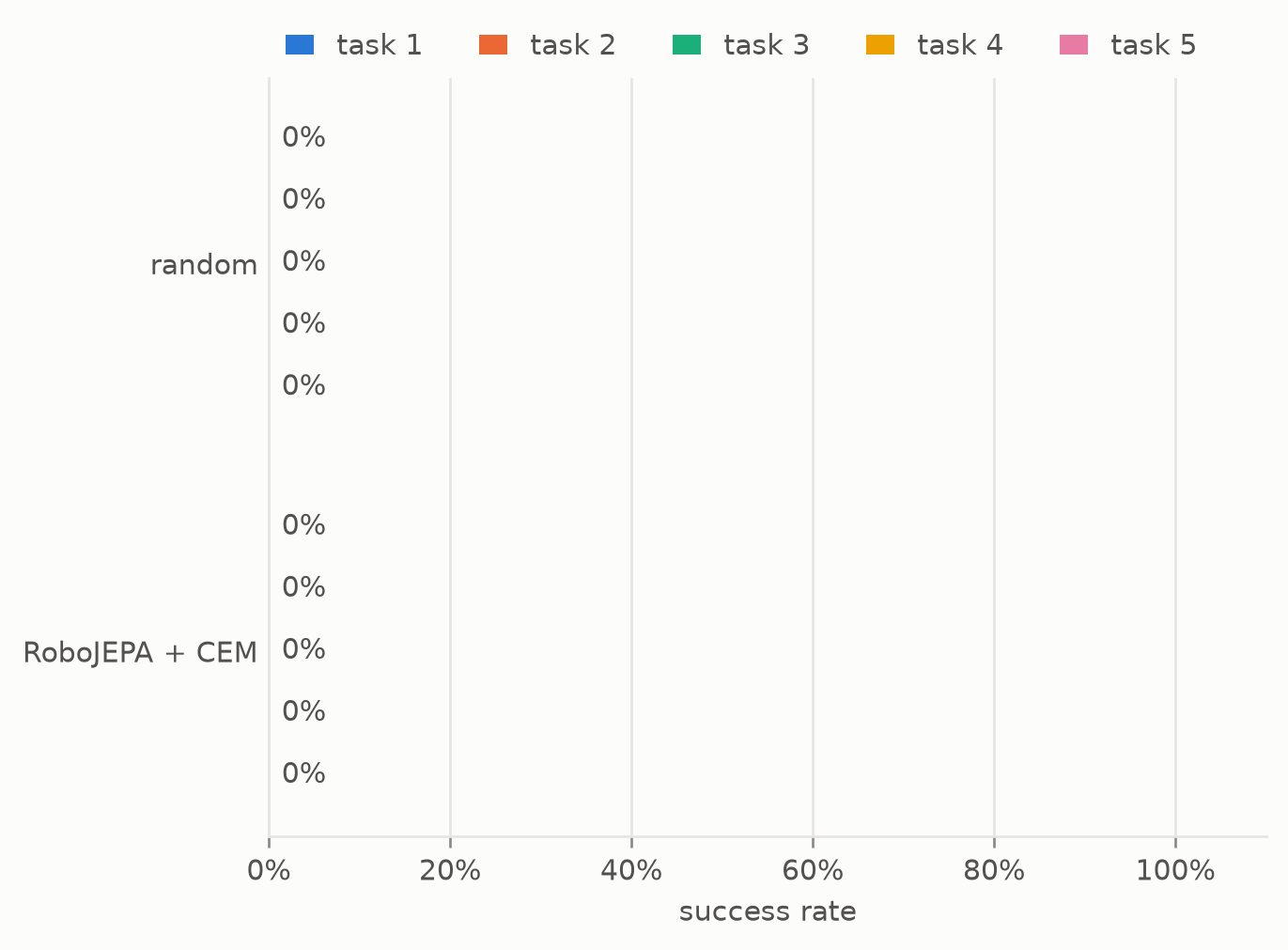
One planned episode per task, beside OGBench's rendering of its goal.
video = torch.stack([videos["RoboJEPA + CEM", t][0][0] for t in range(1, 6)])
goals = torch.stack([videos["RoboJEPA + CEM", t][1][0] for t in range(1, 6)])
tiles = torch.cat([goals[:, None].expand(-1, video.size(1), -1, -1, -1), video])
titles = [f"task {t} goal" for t in range(1, 6)] + [f"task {t}" for t in range(1, 6)]
plots.episodes(tiles[:, ::4], titles=titles, ncols=5, fps=6)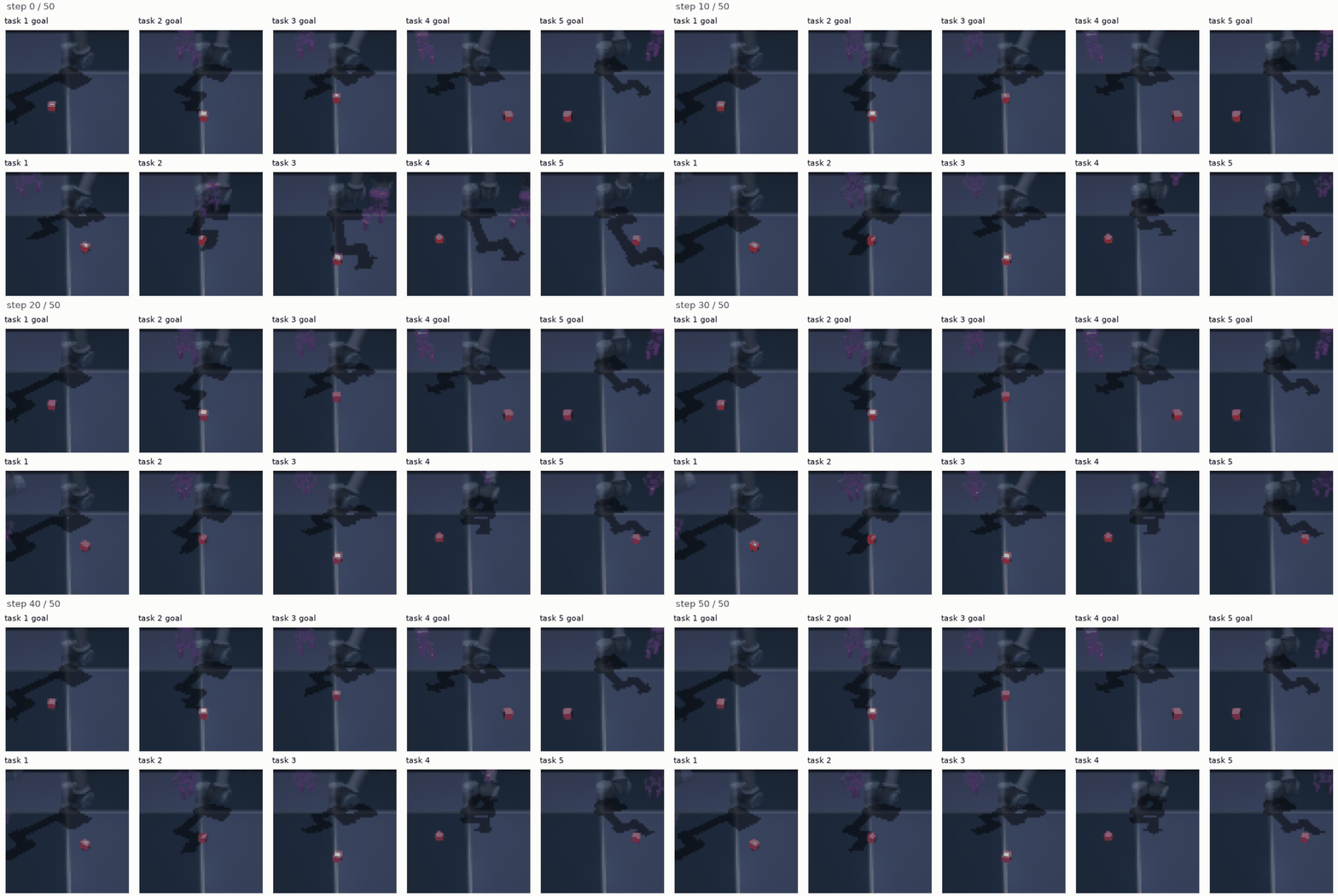
Raw pixel patches and 15k updates make a deliberately small baseline. The usual next steps are the frozen V-JEPA 2.1 encoder RoboJEPA was designed for, the arm's proprioception (load_ogbench(..., info=True) adds qpos and qvel), and longer training. Any other OGBench task works the same way: OGBench(name) and load_ogbench(name) take OGBench's dataset names.