DINO-WM: world models on frozen features, then used to plan
INFO
Esta página aún no está traducida. Leer en inglés

DINO-WM (code) leaves the visual encoder frozen (DINOv2 patch features) and learns only the dynamics: a ViT predictor with frame-level causal attention, plus small action and proprioception encoders. Planning then runs in the frozen feature space.
Two worlds, both simulated in MuJoCo (pip install torch-world[action]):
- a Universal Robots UR10e arm with a Robotiq 2F-85 gripper and a cube, after OGBench
cube-single; - Push-T, pushing a T-shaped block into a goal pose: the paper's benchmark, reproduced with the paper's model, DINOv2 features, data and evaluation protocol.
import importlib.util

if importlib.util.find_spec("torch_world") is None:  # on Colab
%pip install -q "torch-world[examples,action]"import torch
from torch.utils.data import DataLoader
from torch_world import evaluation, metrics, plots
from torch_world.datasets import TrajectoryDataset
from torch_world.envs import PushT, RobotCube
from torch_world.models import DINOWM
from torch_world.nn import PatchTokens, PixelPatches
from torch_world.planning import CEM, RecedingHorizon
torch.manual_seed(0)
device = "cuda" if torch.cuda.is_available() else "cpu"Frozen encoder
With internet access, use DINOv2: encoder = PatchTokens.from_hub("dinov2_vits14"). To stay self-contained and fast, this notebook uses raw 16×16 pixel patches as the frozen features (PixelPatches), so predicted latents can be viewed as images.
encoder = PixelPatches(16)
HISTORY = 3


def train(model, loader, epochs):
    opt = torch.optim.AdamW(model.parameters(), lr=5e-4)
    log = {"visual": [], "proprio": []}
    for epoch in range(epochs):
        for batch in loader:
            out = model(batch["pixels"], batch["actions"], batch["proprio"])
            opt.zero_grad()
            out["loss"].backward()
            opt.step()
            log["visual"].append(out["visual_loss"].item())
            log["proprio"].append(out["proprio_loss"].item())
    return model.eval(), log
Part 1 · UR10e arm
Play data
A noisy scripted policy picks the cube up and puts it down at random spots, like OGBench's play datasets. Actions move the gripper by up to 10 cm and open or close it, five times a second; proprioception is the gripper position and opening.
ROBOT = dict(robot="ur10e", size=96, control_dt=0.2, max_step=0.1)
data = {k: v.to(device) for k, v in RobotCube(batch_size=1024, **ROBOT).collect(24, generator=torch.Generator().manual_seed(0)).items()}
data["proprio"] = data["states"][..., :4]
plots.images(data["pixels"][2, :16].cpu(), [f"t={t}" for t in range(16)], size=1.3)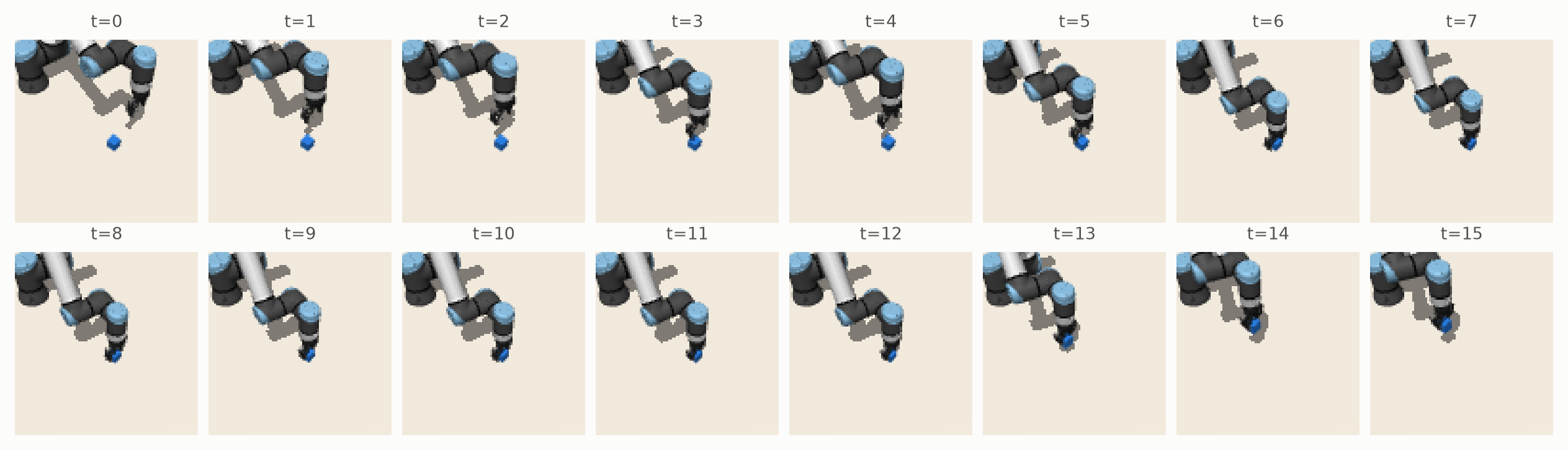
arm = DINOWM(encoder, num_patches=36, embed_dim=encoder.dim, action_dim=4, proprio_dim=4, history=HISTORY, depth=6, num_heads=8, head_dim=64, mlp_dim=1024).to(device)
print(f"{sum(p.numel() for p in arm.parameters() if p.requires_grad) / 1e6:.2f}M trainable parameters")
arm, log = train(arm, DataLoader(TrajectoryDataset(data, HISTORY + 1), batch_size=256, shuffle=True, drop_last=True), 30)
plots.curves(log, smooth=100)19.49M trainable parameters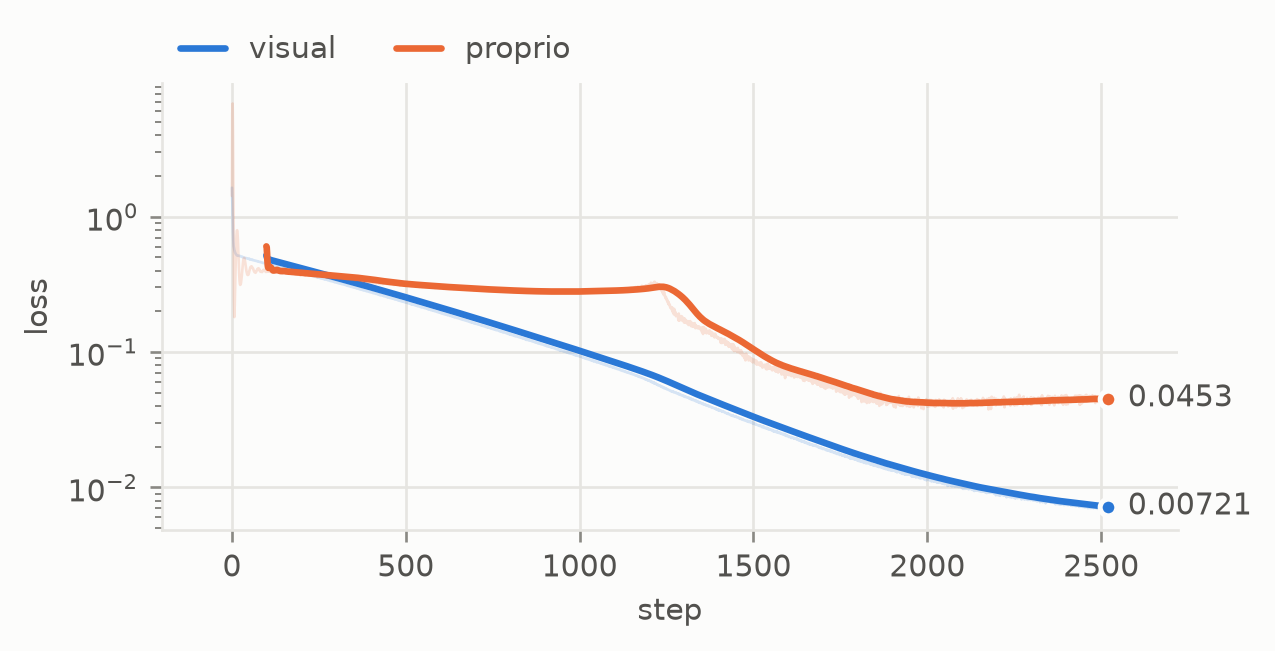
Imagination
From one real frame, the model unrolls the expert's pick-and-place actions in feature space without seeing any more frames. Pixel-patch features decode exactly to images, so imagined frames are scored against the real ones with the image metrics DINO-WM reports for its decoded predictions: SSIM (1 is identical) and PSNR, over 64 held-out episodes.
env = RobotCube(batch_size=64, **ROBOT)
first = env.reset(generator=torch.Generator().manual_seed(5))
target = env.sample_targets(generator=torch.Generator().manual_seed(6))
s0, real, actions = env.state.clone(), [first], []
for t in range(10):
    actions.append(env.expert(target))
    real.append(env.step(actions[-1]))
real = torch.stack(real, 1)
with torch.no_grad():
    z = arm.rollout(arm.encode(first[:, None].to(device), s0[:, None, :4].to(device)), torch.stack(actions, 1).to(device))
imagined = encoder.unpatchify(z.flatten(0, 1), (6, 6)).unflatten(0, z.shape[:2]).clamp(0, 1).cpu()
ssim, psnr = metrics.ssim(imagined, real).mean(0), metrics.psnr(imagined, real).mean(0)
print("step    " + "".join(f"{t:>6d}" for t in range(0, 11, 2)))
print("SSIM    " + "".join(f"{v:6.3f}" for v in ssim[::2].tolist()))
print("PSNR dB " + "".join(f"{v:6.1f}" for v in psnr[::2].tolist()))
keep = list(range(0, 11, 2))
plots.images(torch.cat([real[0, keep], imagined[0, keep]]), ncols=len(keep), size=1.5, rows=["real", "imagined"], titles=[f"t={t}" for t in keep] * 2)step 0 2 4 6 8 10
SSIM 1.000 0.732 0.717 0.697 0.671 0.660
PSNR dB 120.0 19.1 17.6 16.8 16.1 15.5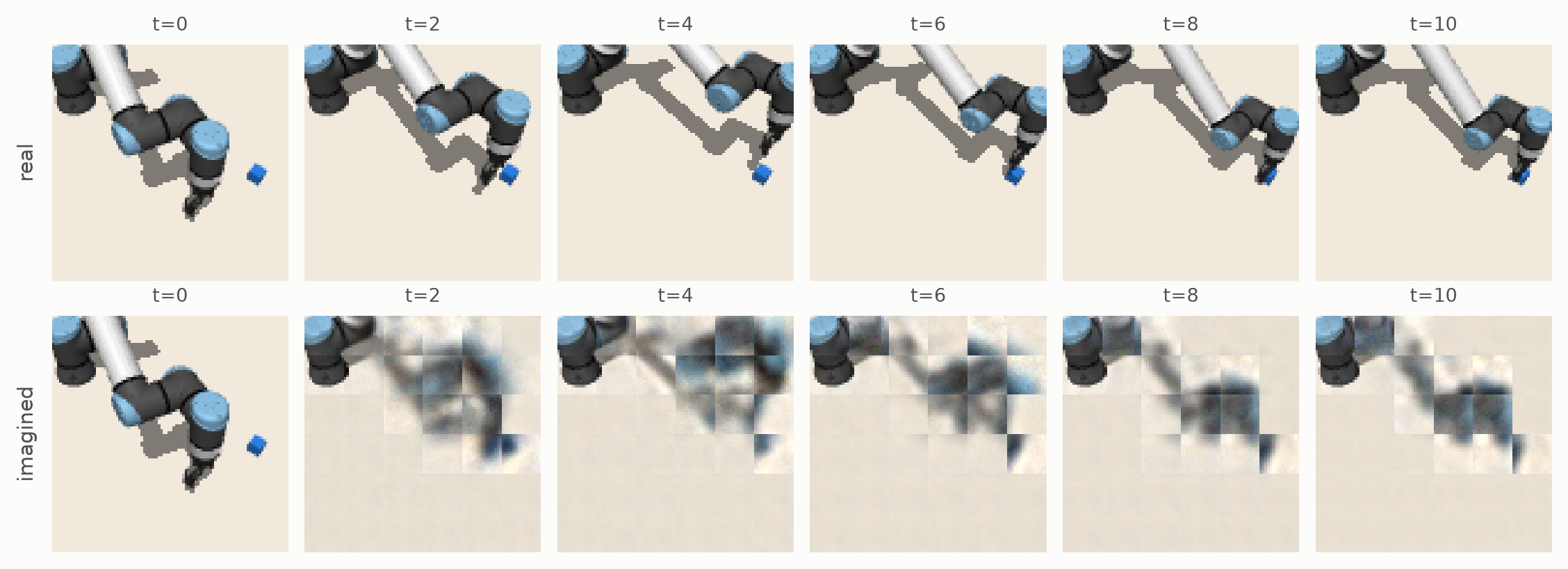
Plan toward goal images
Each task gives a start and the image of a goal state. CEM searches 5-step action sequences in feature space and MPC executes the first action of each plan. The "path" objective scores every imagined step, not only the last, so the planner moves now instead of postponing its moves to the end of the horizon.
Two tasks:
- reach: move the open gripper to the pose in the goal image; success within 5 cm.
- pick and place: carry the cube to the spot in the goal image (OGBench
cube-single); success when the cube rests within 5 cm of it.
The scripted expert and random actions bracket the planner.
Each policy gets the standard measures of goal reaching: the final success rate with its 95% Wilson interval (16 episodes leave wide intervals), the share of episodes that reached the goal at any step and the mean steps to get there, the median final distance (meters), the median progress (fraction of the start distance closed), SPL (success weighted by how direct the path was), action smoothness (mean change between consecutive actions; lower is smoother) and the planning time per step.
def plan_with(model, env, goal_state, proprio, action_dim):
    with torch.no_grad():
        goal = model.encode(env.render(goal_state)[:, None].to(device), goal_state[:, None, proprio].to(device))[:, 0]
    planner = CEM(horizon=5, action_dim=action_dim, num_samples=256, num_elites=32, iterations=10, bounds=(-1, 1), objective="path")
    return lambda obs: planner(model, model.encode(obs[:, None].to(device), env.state[:, None, proprio].to(device)), goal)[:, 0].cpu()


arm_runs = {}
for task, steps in [("reach", 12), ("pick and place", 30)]:
    env = RobotCube(batch_size=16, task=task.split()[0], **ROBOT)
    start, goal_state = env.tasks(generator=torch.Generator().manual_seed(1))
    policies = {"DINO-WM + CEM": plan_with(arm, env, goal_state, slice(0, 4), 4), "scripted expert": lambda obs, env=env, goal_state=goal_state: env.scripted(goal_state), "random actions": evaluation.random_policy(env)}
    arm_runs[task] = evaluation.goal_reaching(env, policies, start, goal_state, steps, record=lambda e, goal_state=goal_state: e.render(size=160, goal=goal_state))
    print(f"== {task}\n{arm_runs[task]}")
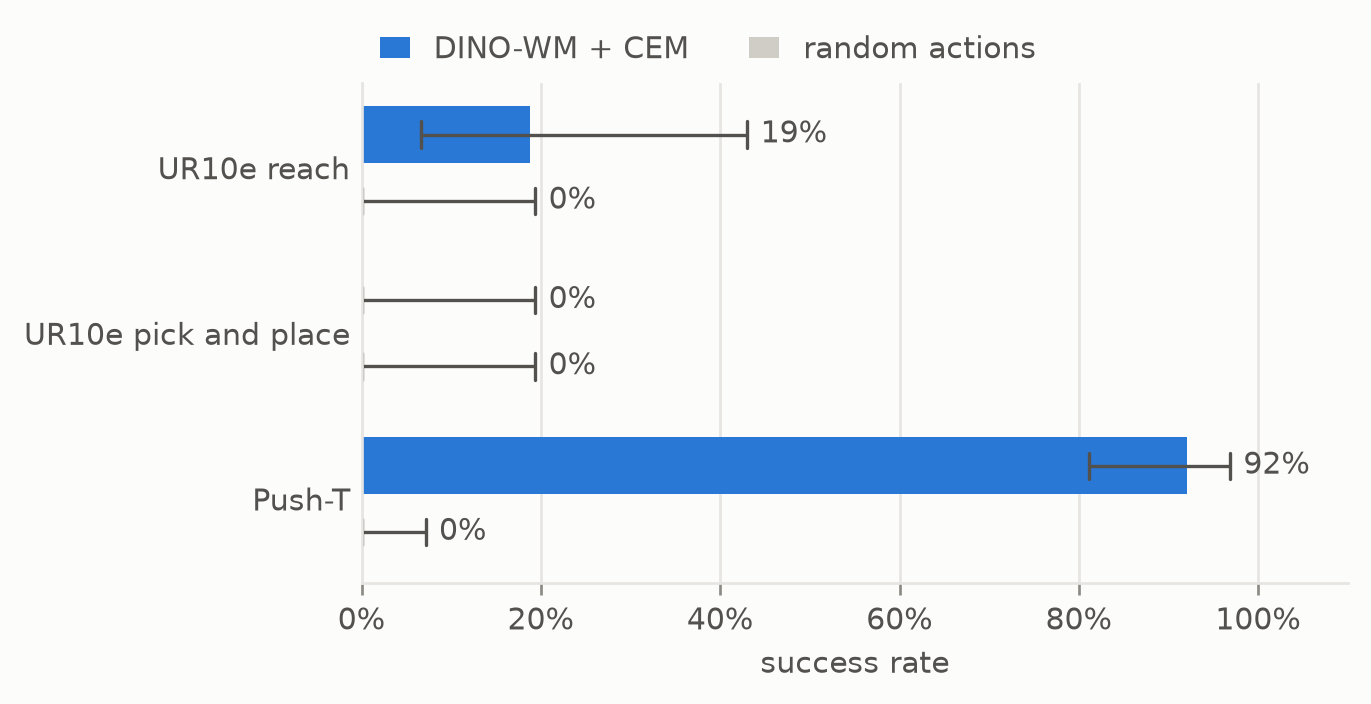
plots.bars({task: r.intervals() for task, r in arm_runs.items()}, xlabel="success rate", baseline="random actions")== reach
success reached steps final distance progress SPL smoothness ms / step
DINO-WM + CEM 19% [7%, 43%] 50% 5.12 0.132 0.434 0.0857 0.623 7.95e+04
scripted expert 100% [81%, 100%] 100% 2.56 6.01e-08 1 0.969 0.151 0.108
random actions 0% [0%, 19%] 6% 3 0.283 -0.121 0 1.56 0.0757== pick and place
success reached steps final distance progress SPL smoothness ms / step
DINO-WM + CEM 0% [0%, 19%] 0% nan 0.191 0 0 0.545 7.95e+04
scripted expert 100% [81%, 100%] 100% 12.1 0.00115 0.991 0.939 0.487 0.295
random actions 0% [0%, 19%] 0% nan 0.194 0 0 1.55 0.0859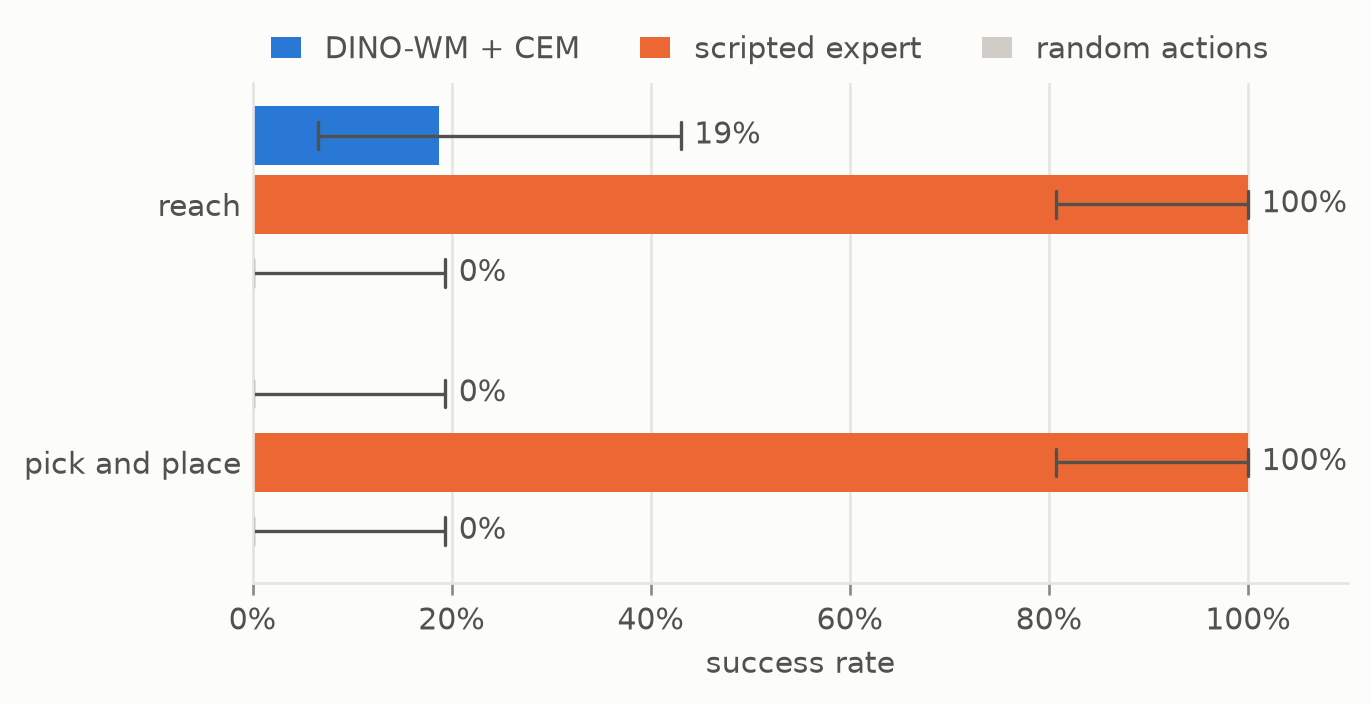
Reaching episodes of the planner. The translucent orange gripper marks the goal (videos only; the model sees the plain scene):
r = arm_runs["reach"]
plots.episodes(r.frames["DINO-WM + CEM"][:8], r.success["DINO-WM + CEM"][:8], [f"{100 * d:.0f} cm → {100 * e:.0f} cm" for d, e in r.distances["DINO-WM + CEM"][:8, [0, -1]].tolist()])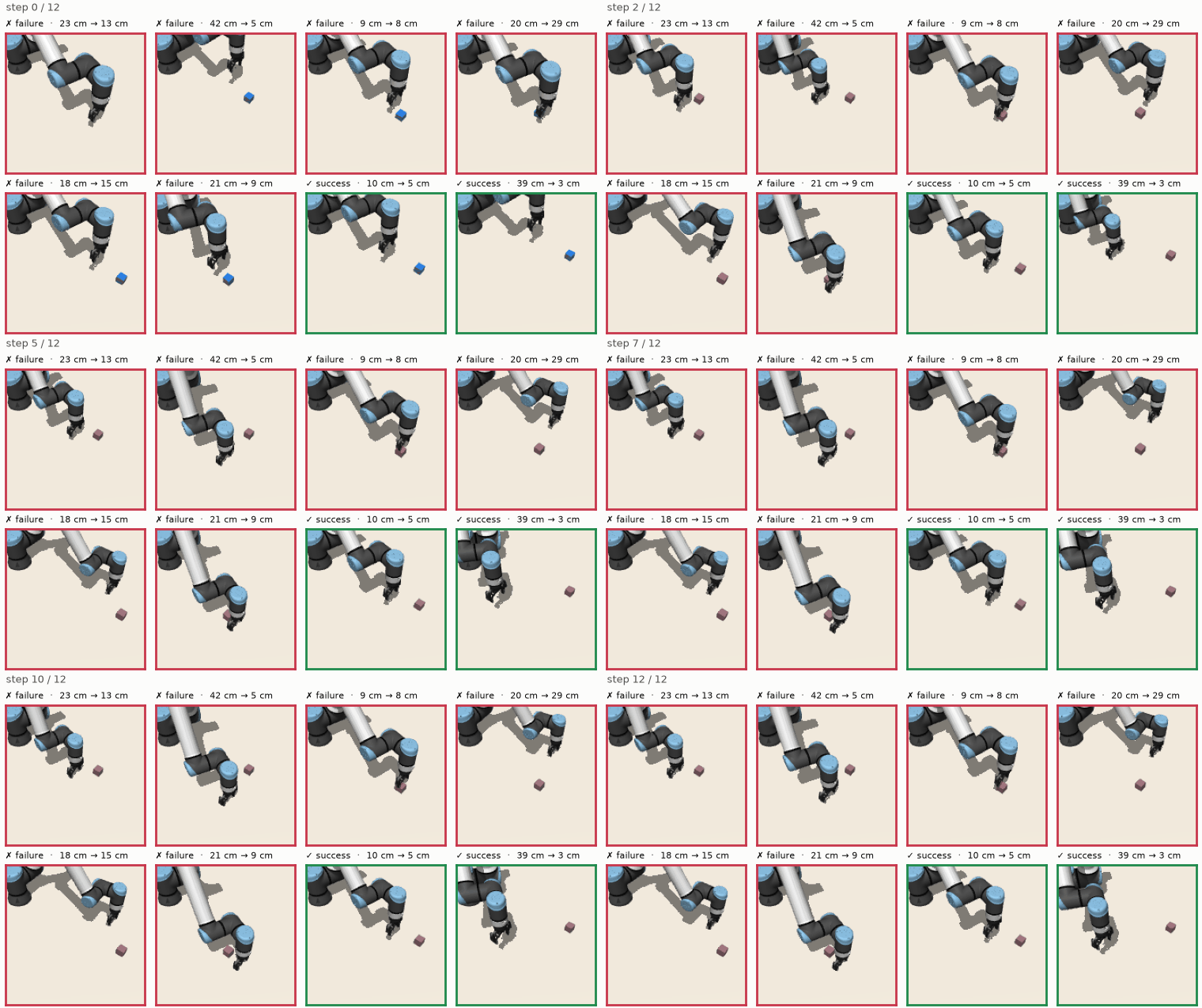
Pick and place is where greedy latent planning breaks down. The planner reaches the arm pose shown in the goal image, but carrying the cube needs a detour (descend, grasp, lift, carry) that a short horizon never finds attractive, and the cube covers only a few patches. The paper reaches such tasks with pre-trained DINOv2 features, more data and longer horizons; here the expert and planner videos show the gap:
r = arm_runs["pick and place"]
plots.episodes(torch.cat([r.frames["scripted expert"][:2], r.frames["DINO-WM + CEM"][:6]]), torch.cat([r.success["scripted expert"][:2], r.success["DINO-WM + CEM"][:6]]), ["expert"] * 2 + ["DINO-WM + CEM"] * 6)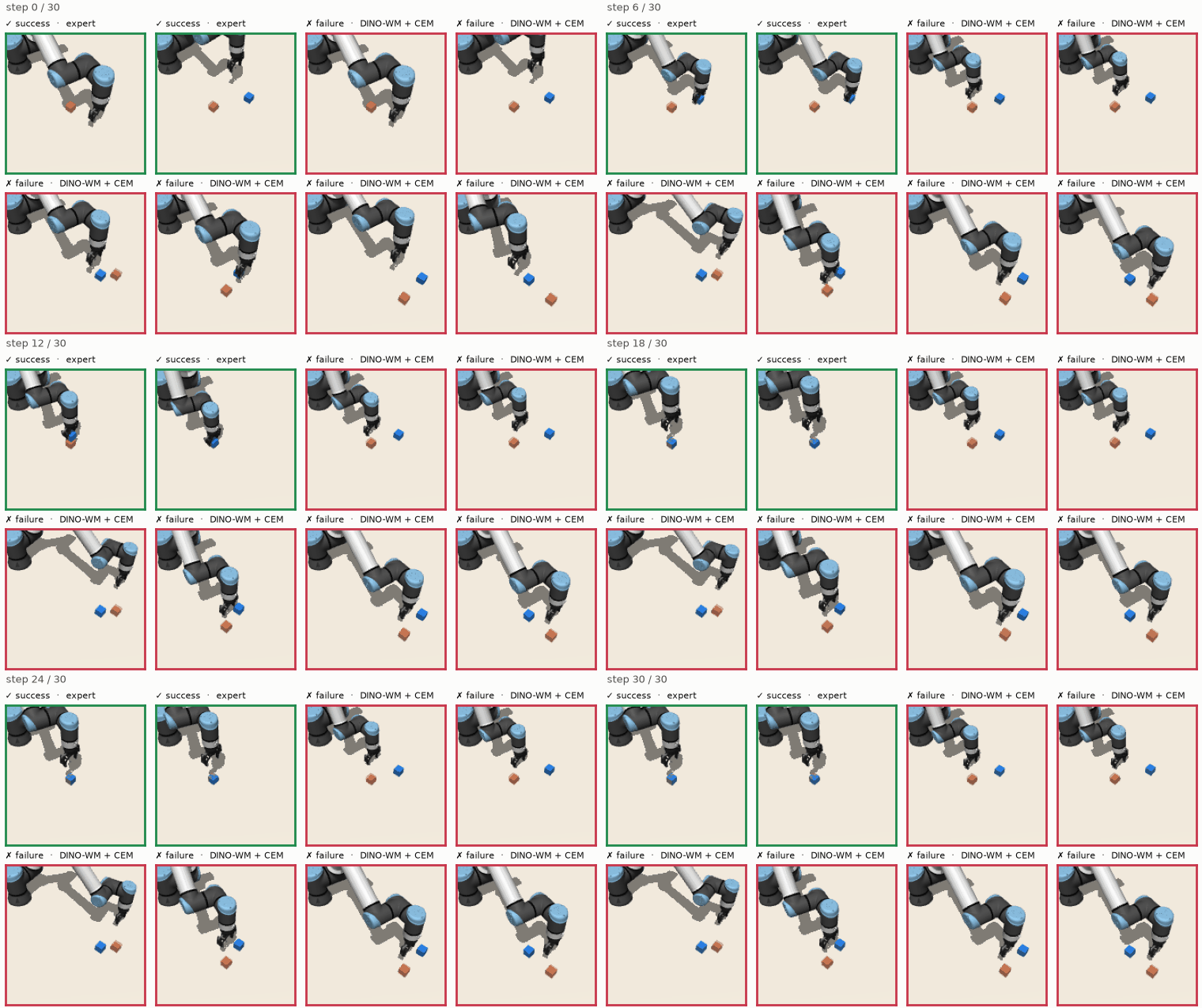
Part 2 · Push-T, reproducing the paper
PushT follows the paper's Push-T (stable-worldmodel's swm/PushT-v1): the same arena, T block, pusher, dynamics and success test, in MuJoCo (see the LeWM notebook).
The model is stable-worldmodel's DINO-WM: frozen DINOv2 ViT-S/14 patch features (256 per 224 px frame), with proprioception (the pusher's position and velocity) and action embeddings on every patch, and a frame-causal ViT predictor. It was trained with that recipe on the paper's 18,685 expert episodes replayed in this env, outside the notebook. Here we load it from checkpoints/ and evaluate it on the paper's tasks: each start is a state of an expert episode, and its goal the state the expert reached 25 steps later.
tasks = torch.load("checkpoints/pusht_expert_tasks.pt")  # start and goal states, (500, 7) each
env = PushT(batch_size=50, size=224)
plots.images(torch.cat([env.render(tasks["start"][:6]), env.render(tasks["goal"][:6])]).cpu(), ncols=6, size=1.5, rows=["start", "goal"])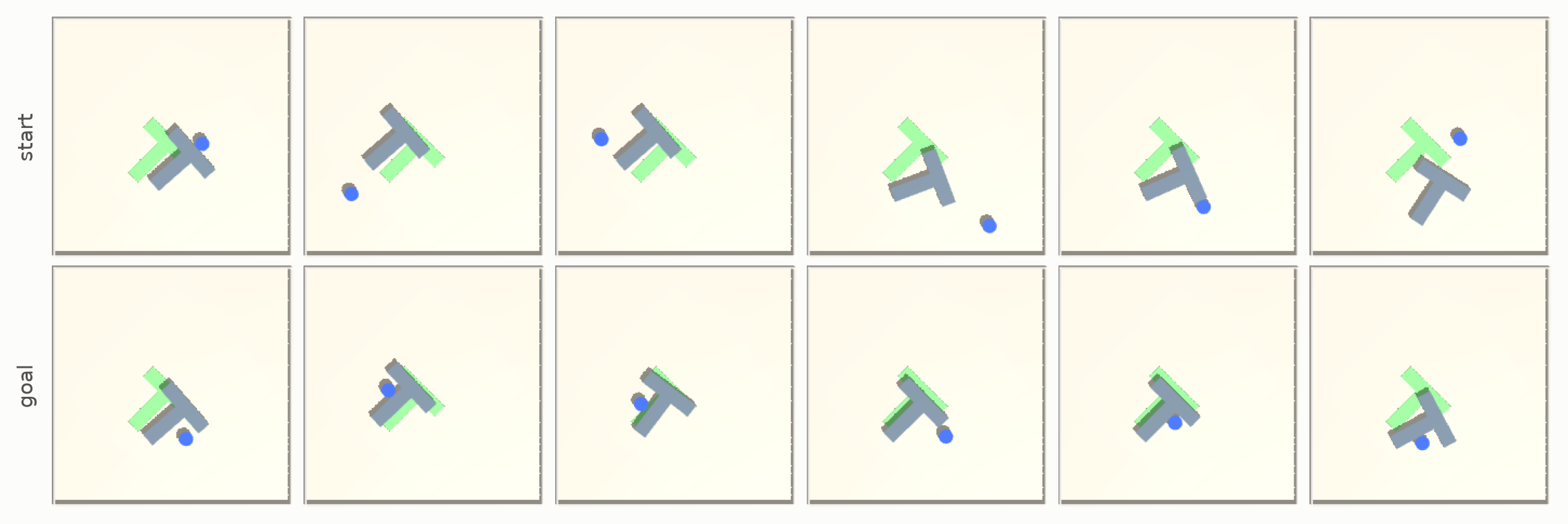
CHECKPOINT = "checkpoints/dinowm_pusht_mj.pt"  # the trained DINOWM state dict, without the frozen encoder (loaded from torch hub)
dino = PatchTokens.from_hub("dinov2_vits14", size=None)
pt = DINOWM(dino, num_patches=256, embed_dim=dino.dim, action_dim=10, proprio_dim=4, history=HISTORY, depth=6, num_heads=16, head_dim=64, mlp_dim=2048).to(device)
missing, unexpected = pt.load_state_dict(torch.load(CHECKPOINT, map_location=device), strict=False)
assert not unexpected and all(k.startswith("encoder.") for k in missing)
pt.eval()
print(f"{sum(p.numel() for p in pt.parameters() if p.requires_grad) / 1e6:.1f}M trained parameters on a frozen {sum(p.numel() for p in dino.parameters()) / 1e6:.1f}M encoder")20.2M trained parameters on a frozen 22.1M encoderEvaluate with the paper's protocol
As stable-worldmodel's eval_wm.py: the model plans in the z-scored action space of its training data, with z-scored proprioception. CEM samples 300 plans of 5 blocks of 5 actions, refits to the 30 cheapest for 30 iterations, and scores a plan by the distance between its last imagined features and the goal's (visual features plus proprioception, DINO-WM's cost). The policy executes the whole plan, 25 steps, before planning again; each episode gets 50 steps, and succeeds when the goal is reached at any step. Each task is planned on its own, as in the reference: 300 candidates × 3 frames × 256 patches fill the GPU.
The expert data keeps the reference's axes and units (pixels, y down), so proprioception is read in those units and plans flip y before they reach the env.
ACTION_MEAN, ACTION_STD = torch.tensor([-0.0078, 0.0069]), torch.tensor([0.2082, 0.2065])  # of the expert data
PROPRIO_MEAN, PROPRIO_STD = torch.tensor([228.34, 292.22, -2.97, 2.55]), torch.tensor([103.32, 98.90, 77.07, 76.68])
FLIP_Y = torch.tensor([1.0, -1.0])
pt_planner = CEM(horizon=5, action_dim=10, num_samples=300, num_elites=30, iterations=30)


def embed(model, images, states):
    proprio = PushT.to_reference(states.double().cpu())[:, [0, 1, 5, 6]].float()  # pusher position and velocity
    with torch.autocast(device, torch.bfloat16):
        return model.encode(images.to(device)[:, None], ((proprio - PROPRIO_MEAN) / PROPRIO_STD).to(device)[:, None]).float()


def plan_pusht(model, env, goal_state):
    with torch.no_grad():
        goal = embed(model, env.render(goal_state), goal_state)[:, 0]

    def plan(obs):
        z = embed(model, obs, env.state)
        with torch.autocast(device, torch.bfloat16):
            blocks = torch.cat([pt_planner(model, z[i : i + 1], goal[i : i + 1]) for i in range(len(z))]).float().cpu()
        return ((blocks.unflatten(-1, (5, 2)) * ACTION_STD + ACTION_MEAN) * FLIP_Y).flatten(-2)

    return RecedingHorizon(plan, action_dim=2, execute=5)


start, goal_state = tasks["start"][:50], tasks["goal"][:50]
policies = {"DINO-WM + CEM": plan_pusht(pt, env, goal_state), "random actions": evaluation.random_policy(env)}
pt_run = evaluation.goal_reaching(env, policies, start, goal_state, steps=50, record=lambda e: e.render(size=160, goal=goal_state))
pt_success = {name: metrics.success_rate(r[:, 1:].any(1)) for name, r in pt_run.reached.items()}  # the paper's measure
print(pt_run)
print("\nreached the goal (paper's success):", "   ".join(f"{name} {rate}" for name, rate in pt_success.items()))
plots.distances(pt_run.distances, radius=env.radius) success reached steps final distance progress smoothness ms / step coverage
DINO-WM + CEM 92% [81%, 97%] 92% 22.8 0.0038 0.826 0.256 1.21e+05 88%
random actions 0% [0%, 7%] 0% nan 0.0309 0 1.04 0.0914 48%
reached the goal (paper's success): DINO-WM + CEM 92% [81%, 97%] random actions 0% [0%, 7%]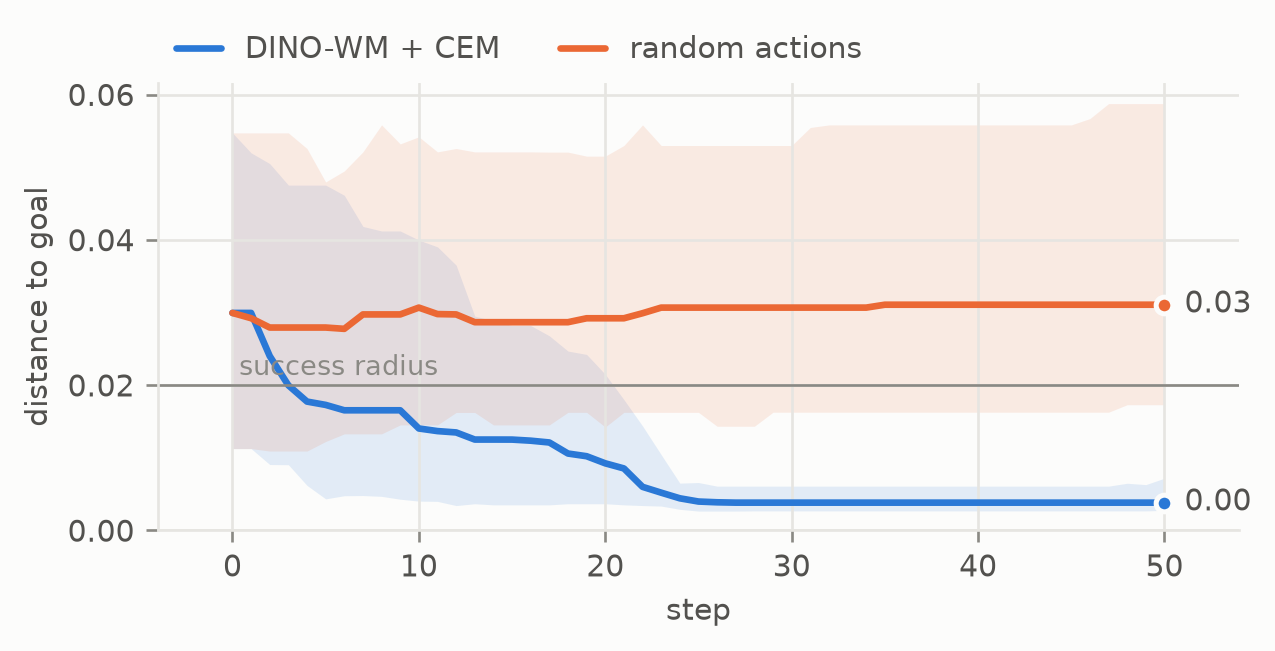
Episodes of the planner. The green T is the target drawn in every frame, as in the paper's renders; the translucent orange T marks this episode's goal (videos only):
won = pt_run.reached["DINO-WM + CEM"][:, 1:].any(1)
plots.episodes(pt_run.frames["DINO-WM + CEM"][:8], won[:8])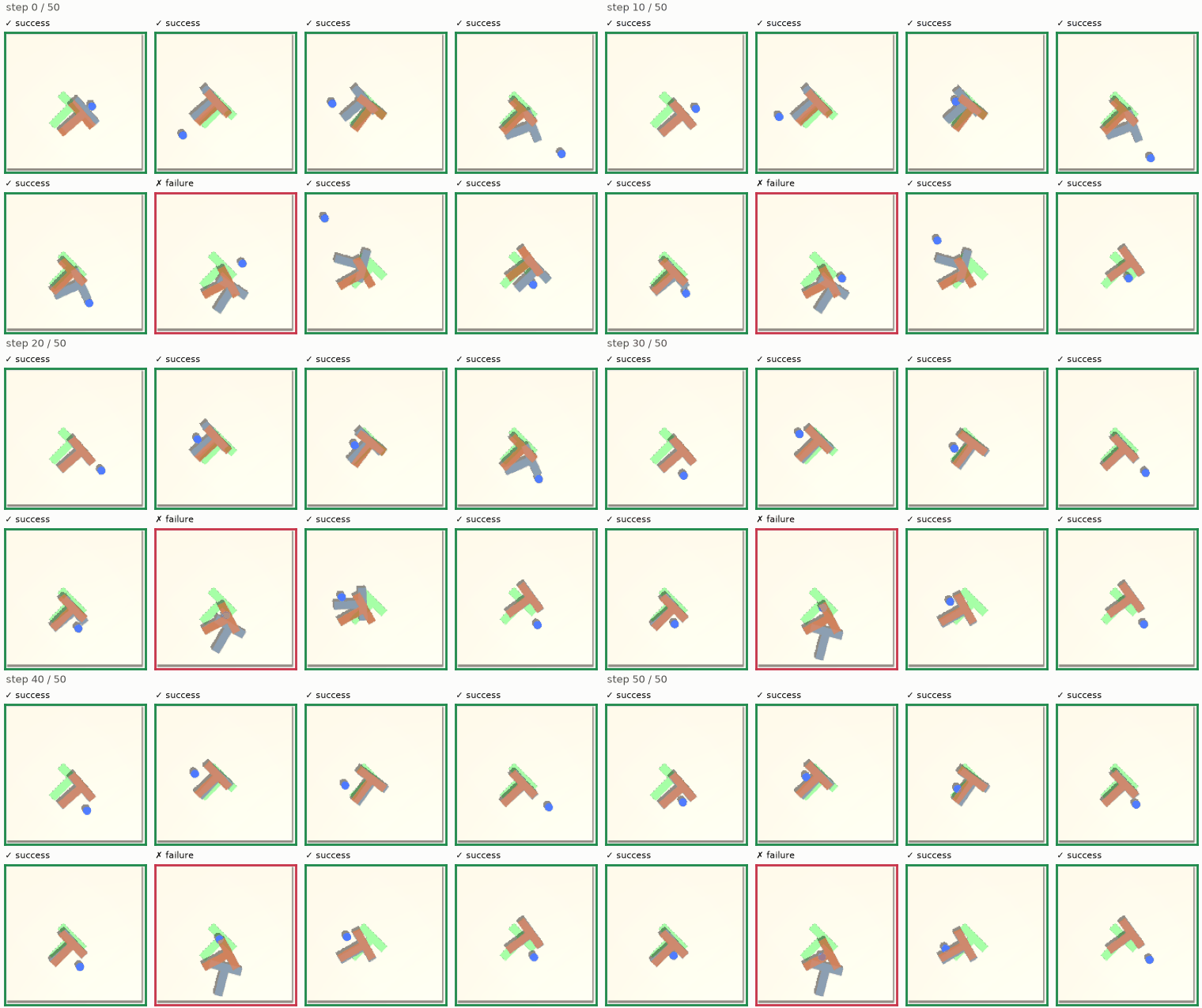
Where the T went (the path darkens over time), from above:
paths = pt_run.paths["DINO-WM + CEM"][:8]
plots.trajectories(env.position(paths), env.position(goal_state[:8]), radius=env.radius / env.top_size, scale=env.top_size, background=env.render(goal_state[:8], camera="top", size=192), success=won[:8])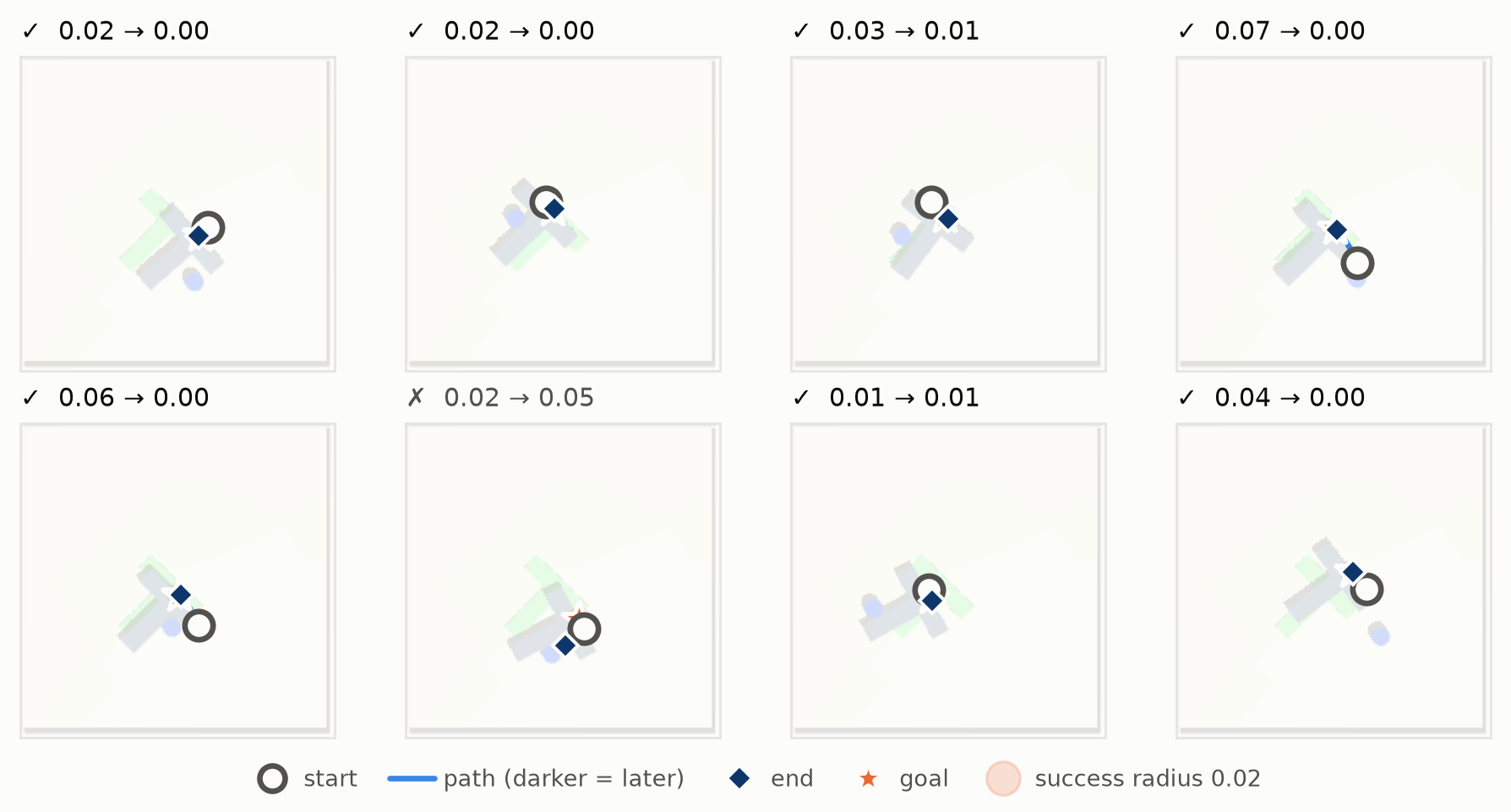
Summary
Arm tasks score the final step; Push-T scores reaching the goal at any step, as the paper does.
results = {"UR10e reach": arm_runs["reach"].intervals(), "UR10e pick and place": arm_runs["pick and place"].intervals(), "Push-T": pt_success}
plots.bars({name: {k: r[k] for k in ("DINO-WM + CEM", "random actions")} for name, r in results.items()}, xlabel="success rate", baseline="random actions")